
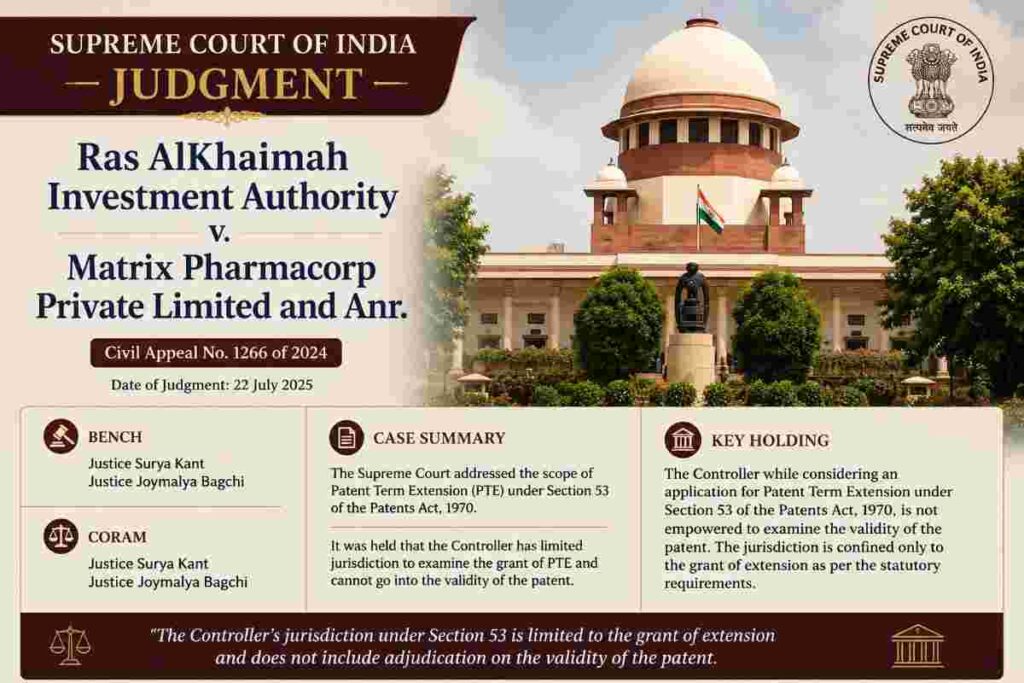

Breif Facts
Ras Al Khaimah Investment Authority (RAKIA), a public entity established under Emiri Decree No. 2 of 2005, advanced substantial funds to Nimmagadda Prasad (NP) for investment in the VANPIC Project—a government-to-government initiative involving port and industrial development in Andhra Pradesh. RAKIA alleges that NP fraudulently misappropriated these funds. In UAE proceedings (Civil Case No. 60/2020), the Ras Al Khaimah Court of First Instance (02.02.2022) found RAKIA to be a fraud victim and ordered NP to pay AED 267,941,374 (approximately ₹543.92 crores) with 6% per annum interest from 05.10.2021. This judgment was upheld by the Superior Court on 27.12.2022 (“RAK Foreign Decree”). RAKIA subsequently initiated execution proceedings in Hyderabad and Ranga Reddy commercial courts. The core dispute centers on whether NP and related entities engaged in systematic asset dissipation and whether the corporate veil should be pierced to reach family-controlled entities including Matrix Pharmacorp, Tianish Laboratories, IQuest Enterprises, and Moschip Technologies.
Procedural History
- UAE Courts (2020 – 2022): RAK Foreign Decree obtained against NP
- Commercial Courts, Hyderabad and Ranga Reddy (2023-Present): Two execution petitions filed; NP’s assests worth 212 crores attached.
- Commercial Court, Hyderabad (May 2024): IQuest filed counter-affidavit stating it decided not to acquire viatris.
- High court, Telangana 2024-2025: Contempt proceedings dismissed; impleadment of Matrix and Tianish stayed
- NCLT (10.03.2025): Approved Matrix-Tianish merger; granted protective orders restricting asset alienation
- NCLAT (24.04.2025): Reversed NCLT’s protective orders; dismissed appellant’s appeals
- Supreme Court (15.10.2025 onwards): Status quo orders imposed; mediation attempted; present judgment delivered
Legal Issues Before the Court
- Whether IQuest’s statement (not going ahead with Viatris acquisition) constituted a binding undertaking attracting contempt of court.
- Whether the Matrix-Tianish merger violated any undertaking and contitution asset dissipation.
- Whether the corporate veil should be pierved to treat family -controlled entities as unified structure liable for the decree.
- Whether the RAK Foreign Decree is prima facie excutable under Section 44A, CPC, 1908.
- Whether additional security should be imposed pending final disposal of execution proceedings
- Whether the protective orders granted by NCLT should be restored
Relevant Legal Provisions
Code of Civil Procedure
- Section 44A: Execution of decrees of superior courts of reciprocating territories
- Section 60: Property subject to execution
- Sections 13(a)–13(f), 47: Objections to execution and disposal proceedings
Contempt of Courts Act, 1971
- Section 2(b): Definition of undertaking
- Section 19: Right of appeal (against orders finding guilty of contempt)
Companies Act, 2013
- Section 230: Scheme of amalgamation (merger provisions)
Arguments of the Parties
RAKIA’s Arguments
- RAK Foreign Decree is valid and substantially unsatisfied after six years
- NP and family members engaged in systematic asset dissipation through a web of corporate entities
- The statement by IQuest constituted a binding undertaking; subsequent merger violated it.
- Corporate veil should be pierced under alter ego doctrine given pervasive family control.
- Timing of transactions (around enforcement) suggests deliberate asset shielding Additional security must be furnished to secure decree execution
NP and Family Member’s Counter Arguments
- RAK Foreign Decree is prima facie not executable.
- No undertaking was given; IQuest’s statement was merely clarificatory.
- No asset dissipation; security already furnished (₹225 crores cash + ₹400 crores land)
- Corporate entities are independent with separate legal personalities
- Multiple applications (32) constitute “strangulation” of legitimate business
- Family members are strangers to the decree and should not be restrained
Matrix and Tianish’s Arguments
- Separate juristic entities with distinct personalities
- NP never held shares or exercised control over Matrix
- Transaction financed through private equity (Kotak) and institutional funding
- No corporate veil piercing on mere suspicion; requires clear evidence on pleadings
- Merger is ordinary corporate restructuring, not asset dissipation.
Court’s Reasoning
The Court adopted a structured approach:
On under taking and Contempt: Following Babu Ram Gupta v. Sudhir Bhasin (1980) 3 SCC 47 and Patanjali Ayurved Ltd., In re v. Union of India (2024) 19 SCC 193, the Court held that an undertaking must involve a “firm conviction” to bind a party. IQuest’s statement—that it decided not to pursue Viatris acquisition—was merely clarificatory, not a solemn, express commitment. The High Court’s dismissal of contempt proceedings was upheld.
On Asset Dissipation Apprehension: Despite no formal contempt, the Court acknowledged genuine concern regarding systematic reorganization of NP’s holdings. The timing of corporate restructuring (coinciding with enforcement) and the circuitous routing through Matrix warranted protective measures.
On Foreign Decree Enforceability: The RAK Foreign Decree is a superior court judgment from a reciprocating territory. Principles of international comity demand respect. Prima facie executability is established; objections must be addressed in execution proceedings.
On Corporate Veil: The Court refrained from piercing the corporate veil, noting that complex questions of control, shareholdings, and financial independence are unsuitable for summary proceedings. These matters require detailed adjudication before commercial courts with full evidence.
On Security: The Court deemed additional security justified given decree value (₹949.96 crores as of 23.07.2026) against furnished security (₹231.70 crores cash + disputed ₹250 crores land valuation = approximately ₹481.70 crores).
Ratio Decidendi
The main legal principle established: A statement made by a party before court, even if not explicitly labeled an “undertaking,” constitutes contempt-attracting undertaking only if it reflects a firm conviction to be legally bound and is intended to be acted upon by the court. Mere clarificatory or tentative statements, regardless of subsequent conduct inconsistent therewith, do not rise to the level of contemptuous breach. However, where a pattern of corporate restructuring suggests apprehension of asset dissipation in execution of a foreign decree, interim protective orders and additional security requirements are justified on equitable grounds, without prejudging the question of piercing corporate veil.
Obiter Dicta: The Court observed that the pervasive family control over business entities and the timing of transactions raise genuine concerns meriting investigation but cannot be finally adjudicated in the context of interlocutory proceedings.
Important Case Laws Relied Upon
- Babu Ram Gupta v. Sudhir Bhasin (1980) 3 SCC 47
- Principle: Undertaking must be solemn, express, and clearly recorded; cannot be presumed from ambiguous statements
- Bhatnagars and Co. Ltd. v. Union of India [AIR 1957 SC 478]
- Principle: Undertaking must be carefully construed; implied undertakings cannot be assumed absent clear record.
- Patangali Ayurved Ltd., In re v. Union of India (2024) 19 SCC 193
- Principle: Undertaking may be given by filing, affidavit, or clear oral statement; breach equals contempt; words used and circumstances determine whether statement amounts to undertaking.
Final Decision (Operative Result)
Appeals Disposed of as follows:
- IQuest’s statement does not constitute binding undertaking: High Court’s dismissal of contempt proceedings upheld.
- Additional secuity for Rs. 200 crores directed to be furnished by NP and Respondent entitites within two weeks.
- Existing deposites subject to outcome of pending execution proceedings.
- Corporate veil piercing and unified structure question left open for adjudication in commercial court execution proceedings
- NCLAT’s reversal of NCLT’s protective orders not disturbed at this stage
- Commercial Courts directed to expeditiously decide main execution petitions and applications within four months.
Key takeaways for law students and Judiciary Aspirants
- Undertaking Doctrine: Mere statements or clarifications before court do not automatically constitute binding undertakings attracting contempt liability; solemn intent to bind and clear recording are essential
- Foreign Decree Enforcement: UAE decrees are executable in India under Section 44A, CPC as reciprocating territory judgments; principles of international comity cannot be undermined by subsequent asset restructuring
- Corporate Veil—Timing Context: Pattern and timing of corporate restructuring around enforcement can trigger apprehension justifying interim protective orders, but formal veil piercing requires detailed adjudication on pleadings and evidence
- Interlocutory vs. Final: Summary contempt proceedings are unsuitable for examining complex questions of corporate control; such matters belong to execution proceedings with full documentary evidence
- Decree Holder’s Equitable Rights: Foreign decree holder entitled to interim protection through additional security requirements to prevent asset dissipation, balancing with business operational needs
- Multi-Layered Litigation Strategy: A decree holder pursuing enforcement across multiple forums (execution court, high court, appellate tribunal, supreme court) is permissible where genuine dissipation concerns exist
- Execution Timeline: Commercial courts must expedite execution proceedings; indefinite delays prejudice decree enforcement and undermine comity principles.
Case Details
| Details | Information |
| Case Name | Ras Al Khaimah Investment Authority v. Matrix Pharmacorp Private Limited & Anr. |
| Court | Supreme Court of India |
| Bench | V. Mohana, J., Surya Kant, CJI, Joymalya Bagchi, J |
| Citation | 2026 ICSC 932 |
| Case Numbers | Civil Appeal Nos. 12993-94 of 2025; C.A. Nos. 12561-12566 of 2025; SLP (C) Nos. 27277-27279 of 2025; SLP (C) No. 35892 of 2025 |
| Date of Judgement | September 1, 2026 |
| Nature | Civil Appellate; Foreign Decree Execution; Corporate Veil; Asset Dissipation |