

Brief Facts
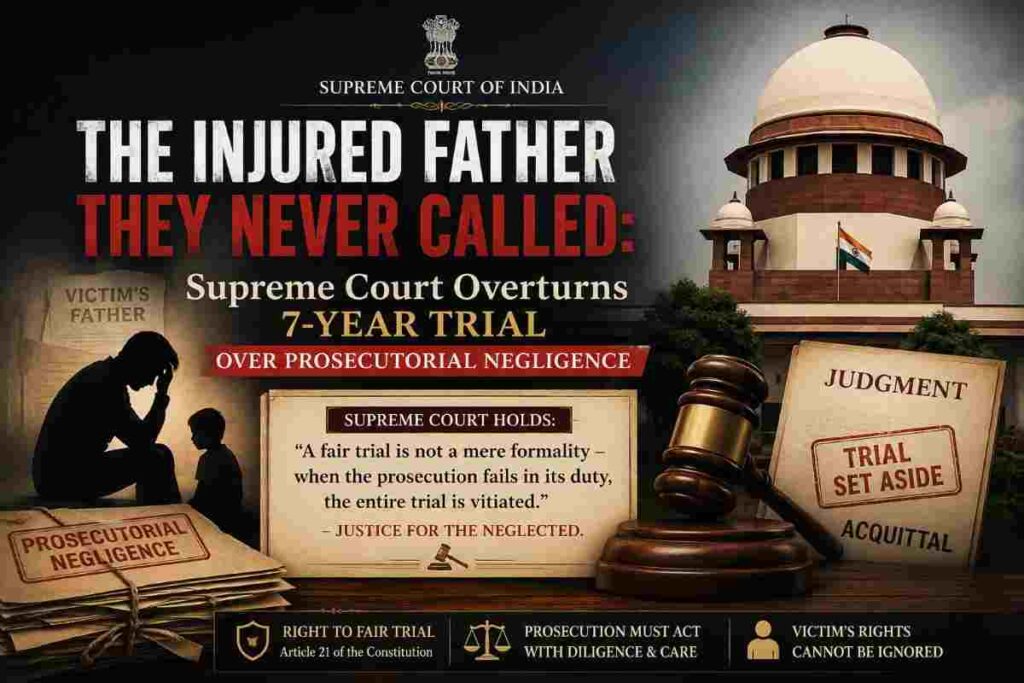
An altercation occurred between the appellant Anil Singh and multiple accused persons. During this incident, accused No. 1 attacked the appellant’s father with a spear, accused Nos. 3 and 4 (both women) assaulted the appellant’s father with an iron rod, and accused No. 2 struck the appellant on the head with a sword. The appellant sustained injuries in the incident, as did his father. Following investigation, a charge was filed against accused No. 1 and No. 2 only; charges against accused Nos. 3 and 4 were dropped. Cognizance was taken by the trial court against accused No. 1 and No. 2. The trial proceeded before the Additional District and Sessions Judge-II, Gopalganj, for nearly a decade (commenced in 2017). During examination-in-chief of the accused under Section 313 CrPC (commenced on April 13, 2024), the appellant filed an application seeking examination of critical witnesses who had not been examined by the prosecution.
Procedural History
- Trial Court Level: The Additional District and Sessions Judge-II, Gopalganj, rejected the application under Section 311 CrPC, holding it to be a dilatory tactic and an attempt to plug lacunae in the prosecution’s case.
- High Court Level: The High Court of Judicature at Patna confirmed the Trial Court’s order through its judgment dated May 8, 2026 (CRLM No. 64140/2024).
- Supreme Court Level: The appellant filed a Special Leave Petition (SLP) before the Supreme Court. The Supreme Court granted leave and allowed the appeal, setting aside the orders of both the Trial Court and the High Court.
Issues Before the Court
The principal legal question was: Whether an application under Section 311 CrPC to examine witnesses after examination-in-chief of the accused under Section 313 CrPC has commenced is maintainable or constitutes a dilatory tactic?
Relevant Legal Provisions
| Old Provision (CrPC) | Current Provision | Subject |
| Section 311 CrPC | Section 348 BNSS | Court’s Power to Summon Witnesses; Examination of Additional Witnesses |
| Section 313 CrPC | Section 351 BNSS | Examination of accused |
Arguments of the parties
Appellant’s Arguments:
- Critical witnesses (the injured father, the treating physician, and the investigating officer) had not been examined by the prosecution.
- The application was not dilatory; rather, it sought to cure deficiencies in the prosecution’s case.
- The absence of these crucial witnesses could result in acquittal despite available evidence.
- The Trial Court and High Court erred in dismissing the application.
State’s Arguments (Respondent):
- The application was filed late in the trial, after examination of the accused had commenced, indicating dilatory intent.
- It was an attempt to plug gaps in the prosecution’s evidence that should have been presented earlier.
- Permitting such applications would encourage procedural delays and tactical manipulation.
Court’s Reasoning
The Supreme Court acknowledged that ordinarily, it would not entertain an Article 136 petition under the Constitution. However, the Court found exceptional circumstances warranting intervention due to a “clear failure of the prosecution to properly conduct the trial.”
The Court noted that both the injured parties (the appellant and his father) were central to the case. Critically, the appellant’s father—the person directly attacked with a spear—had not been examined. Similarly, the treating physician and the investigating officer, described as “crucial witnesses,” had been entirely omitted by the prosecution.
The Court emphasized that the prosecution’s duty is to proffer material witnesses to establish its case. Where crucial evidence-bearing witnesses are not presented, it creates a risk of acquittal not on merit but on the basis of shoddy prosecution. The trial court is not a “moot spectator” but has an independent responsibility to ensure that material evidence is not suppressed.
The Court held that the Court itself has a constitutional duty to ensure that the best evidence is not deliberately withheld, particularly when such omission could lead to wrongful acquittal. The Court distinguished between permitting dilatory tactics and ensuring justice through complete examination of material facts.
Ratio Decidendi
The main legal principle established: The Court has inherent power under Section 311 CrPC to permit examination of crucial witnesses even after the accused’s examination under Section 313 CrPC has commenced, if the prosecution’s failure to examine such witnesses constitutes a material failure in the conduct of the trial. The trial court’s role transcends passive adjudication; it includes an affirmative duty to ensure that material evidence is not suppressed, and to question prosecution conduct when crucial witnesses remain unexamined.
Obiter Dicta
The Court expressed a cautionary note: When there is total failure of the prosecution in presenting its case, the Trial Court should scrutinize the prosecution’s conduct in not examining crucial witnesses and intervene accordingly. The Court should not remain indifferent to such prosecutorial failures.
Final Decision
- Appeal Allowed
- The orders of the Additional District and Sessions Judge-II, Gopalganj (Annexure P4), and the High Court were set aside.
- The application under Section 311 CrPC was restored before the Trial Court.
- The Trial Court was directed to permit examination of: (i) the injured witness (appellant’s father), (ii) the medical officer, and (iii) the investigating officer.
- The Trial Court was directed to permit examination of any other crucial witnesses omitted by the prosecution.
- All such witnesses shall be examined and made available for cross-examination.
- Section 313 CrPC examination shall resume from the stage it was interrupted, with safeguards ensuring that incriminating circumstances from new witness testimony are put to the accused.
- Pending applications, if any, were disposed of.
Key takeaways
- Section 311 CrPC Applications are Not Absolute Bars: Even after the accused’s examination has commenced, the Court retains discretion to permit examination of crucial witnesses if the prosecution has failed to present them.
- Prosecutorial Failure vs. Dilatory Tactic: The Court distinguishes between a genuine prosecution failure (omitting material witnesses) and a mere dilatory tactic. The former justifies intervention; the latter does not.
- Injured Party as Witness: The injured party/complainant is often a crucial witness and should be examined, even if they file the application themselves.
- Role of Trial Court: The Trial Court is not a passive referee but an active guardian of justice. It must interrogate prosecutorial conduct and prevent suppression of material evidence.
- Crucial Witnesses Defined: Medical officers, investigating officers, and injured parties are recognized as “crucial witnesses” whose examination is material to case adjudication.
- Timing is Not Determinative: Late filing of an application does not automatically render it dilatory if the underlying facts show genuine prosecutorial failure.
- Applicability to BNSS: These principles remain fully applicable under the current criminal law regime (BNSS, 2023) and represent an important development in judicial oversight of prosecutorial conduct.
Case Details
| Details | Information |
| Case Name | Anil Singh @ Anil Kumar Singh v. The State of Bihar and Ors |
| Citation | Criminal Appeal No. of 2026 [SLP (Crl.) No. 12169 of 2026] |
| Court | Supreme Court of India |
| Bench | Hon’ble Justice J.B. Pardiwala & Hon’ble Justice K. Vinod Chandran |
| Date of Judgement | August 24, 2026 |
| Date of Order | August 24, 2026 |
| Jurisdiction | Criminal Appellate |