

Introduction
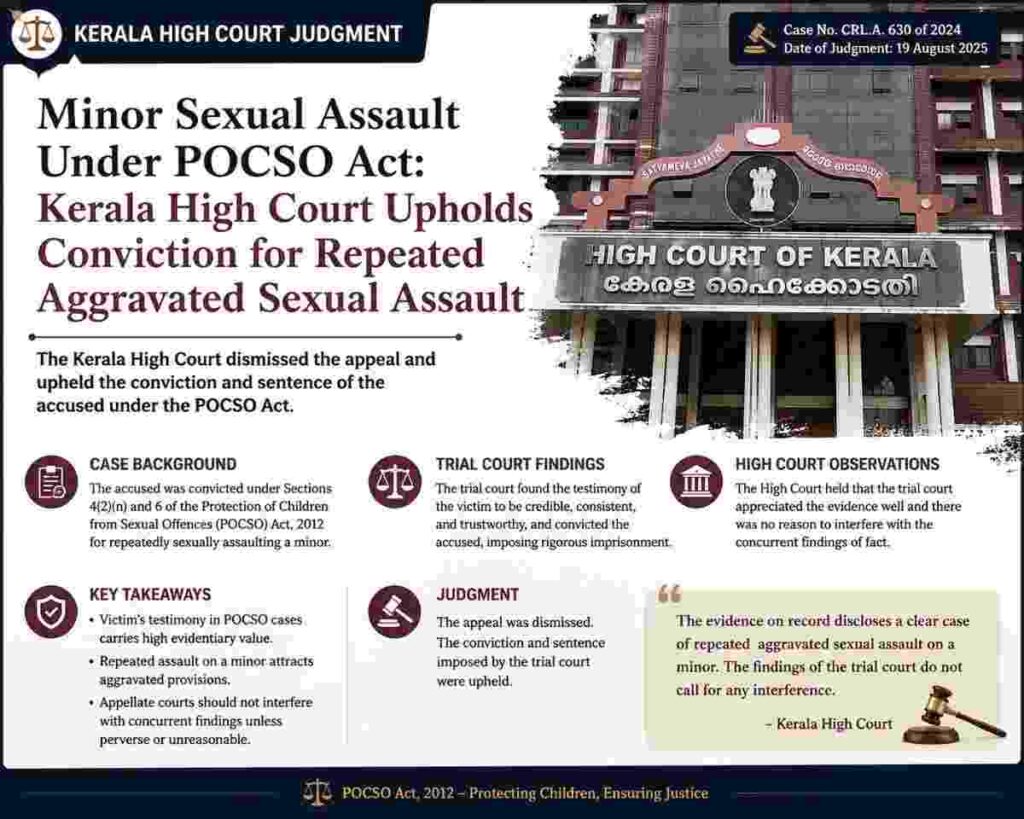
The High Court of Kerala’s judgment in Crl.Appeal No.545/2025 establishes critical legal principles about protecting minors from sexual abuse and the evidentiary value of victim testimony in cases under the Protection of Children from Sexual Offences Act (POCSO Act).
The case involved a 17-year-old girl who was subjected to aggravated sexual assault by a neighbor. The accused challenged his conviction on grounds of false implication and weak evidence. The Kerala High Court rejected these contentions and upheld the 10-year sentence imposed by the Special Court, affirming that the victim’s credible and consistent testimony was sufficient to establish guilt beyond reasonable doubt.
Why this judgment matters: This decision clarifies that:
- A minor’s credible testimony can be the sole basis for conviction in sexual assault cases
- Consensual relationship arguments are irrelevant when the victim is a minor
- Circumstantial inconsistencies (like absence of specific details in investigation reports) do not undermine the core narrative when supported by reliable witness evidence
- A minor’s delayed disclosure is not evidence of false complaint—it reflects normal victim behavior in such traumatic situations
This judgment is essential for legal professionals, judiciary aspirants, law students, and anyone seeking to understand how Indian courts protect child victims of sexual abuse.
Background and Facts of the Case
Chronology of Events
Date of Occurrence: 17th November 2014
The victim, who was 16 years old at the time (born 08.12.1998), was studying in Plus One at Government Higher Secondary School, Kidangara. On the night of 17th November 2014, a temple festival was taking place near her home. Her father and siblings went to watch the festival program, leaving the victim and her mother at home.
At approximately 10 p.m., there was a knock on the door. The victim, expecting her father, opened the door and found the accused (Reji) outside. The accused forcibly grabbed her and dragged her into the courtyard. There, he:
- Removed her clothes and placed her on the ground
- Tied her hands with a shawl to the roots of a nearby jack fruit tree
- Inserted his penis into her vagina
- Committed aggravated sexual assault
The victim felt pain and cried, but her mother did not notice the overt acts as she had taken medicines and gone to sleep. The assault continued for some time until the victim’s father was spotted returning from the church with a torch light. On seeing the light, the accused fled the scene. The victim then untied her hands and stood up.
Immediate Aftermath: Despite the traumatic experience, the victim did not disclose the incident to anyone in her family because she feared her father would become angry and create a quarrel. She kept the incident a secret.
Subsequent Incidents and Delayed Disclosure
Later Incidents: The victim revealed in her testimony that the accused repeated the sexual assault on two more occasions after the initial incident.
Confrontation with Accused: On one occasion, when the accused met the victim on her way to college and spoke about the incidents, she informed her father that the accused was disturbing her. This led to a confrontation between the accused and her father, resulting in a scuffle between them.
Police Complaint: Following this confrontation, the victim’s father questioned her further, and she disclosed the full extent of the sexual abuse. She also informed her father’s sister (PW8) about the disturbance. This information reached the police.
Delay in FIS: Although the occurrence took place on 17.11.2014, the First Information Statement (FIS) was recorded only on 25.12.2015—more than one year later. The accused challenged this significant delay in lodging the complaint.
Complicating Factor: Related Crime (Crime No.725/2015)
On 24.12.2015, just one day before the POCSO complaint was registered, a separate crime (Crime No.725/2015) was registered against the same accused for assaulting the victim’s father. The accused argued that this related assault case was actually the precursor to the sexual assault allegation, and that the POCSO complaint was registered as an “afterthought” to strengthen the case against him for assaulting the father.
This related case eventually ended in compromise with a judgment in C.C.No.144/2016.
Legal Issues Before the Court
The High Court identified three issues for consideration:
1. Whether the Special Court erred in holding that the accused committed the offence punishable under Section 4(1) r/w 3(a) of the POCSO Act?
This was the central issue: Did the prosecution prove beyond reasonable doubt that the accused committed aggravated sexual assault on a minor?
2. Is it necessary to interfere with the impugned judgment in any manner?
Should the High Court set aside the conviction based on the appellant’s arguments?
3. The order to be passed?
If interference is warranted, what order should the High Court pass?
Arguments of the Parties
Appellant’s (Accused’s) Arguments
The learned counsel for the appellant raised five main arguments:
1. False Implication Without Cogent Materials
The appellant argued that he had been falsely implicated in this crime without any supporting evidence. According to him, the complaint was motivated by the assault case against the victim’s father.
2. Fundamental Facts Not Proved
The counsel contended that the fundamental facts regarding sexual assault failed to be proved by the prosecution, and that credible evidence supporting the sexual assault allegation was lacking.
3. Scene Mahazar Does Not Mention Jack Fruit Tree
In Exhibit P6 (the scene investigation report/mahazar), there was no specific mention of a jack fruit tree where the victim was allegedly tied. The counsel argued that this discrepancy undermined the prosecution’s case.
4. Unexplained Delay in FIS
The appellant pointed out that despite the alleged occurrence on 17.11.2014, the FIS was given only on 25.12.2015—a delay of over one year. This delay, the counsel argued, was not properly explained by the prosecution.
5. Related Case Ended in Compromise
The counsel emphasized that Crime No.725/2015 (the assault case against the father) ended in compromise, which strengthens the inference that the entire case, including the sexual assault allegation, was foisted to put the accused behind bars.
Prayer: Based on these arguments, the appellant prayed for the High Court to set aside the conviction and acquit the accused.
Respondent’s (Prosecution’s) Arguments
The learned Public Prosecutor countered the appellant’s contentions with the following arguments:
1. Victim’s Testimony Supported by Corroborative Evidence
The prosecution emphasized that the evidence of the victim (PW1) was strongly supported by corroborative evidence, particularly:
- The sister of the victim’s father (PW8), who testified that she was told about the sexual exploitation by the victim
- The medical evidence from Dr. Deepika K.V. (PW6), whose examination findings were consistent with sexual assault
2. Medical Evidence Supports Sexual Assault
The doctor’s medical certificate (Ext.P7) noted that the victim’s vaginal examination revealed “P/V admits 1 finger loose,” and the doctor opined that there was a “possibility of sexual intercourse.” This was offered as corroborating evidence of the sexual assault.
3. All Ingredients of POCSO Act Offence Established
The prosecutor argued that the evidence satisfactorily established all the ingredients required for an offence under Section 4(1) r/w 3(a) of the POCSO Act:
- The victim was a child (below 18 years)
- Penetrative sexual assault occurred
- It was aggravated (multiple incidents, use of force)
Prayer: The prosecution pressed for confirming the verdict impugned.
Court’s Analysis and Reasoning
1. Proof of Victim’s Age
Finding: The High Court found that the victim’s age as on the date of occurrence (17.11.2014) was below 18 years, making her a “child” as defined under the POCSO Act.
Evidence Relied Upon:
- PW2 (retired Principal of Government Higher Secondary School, Kidangara) produced Ext.P3 (certificate showing date of birth as 08.12.1998)
- Ext.P3(a) (abstract of admission register) also confirmed the date of birth
- PW1 herself deposed her date of birth as 08.12.1998
Court’s Observation: “The status of PW1 as that of a child, as defined under Section 2(1)(d) of the POCSO Act, is not disputed; rather, the prosecution successfully proved the same.”
Significance: Once the victim’s status as a minor is established, several legal principles follow: consent becomes irrelevant, the burden of proof shifts in certain contexts, and special procedural protections apply.
2. Credibility of Victim’s Testimony
Core Finding: The High Court held that PW1’s evidence was “reliable and of sterling quality.”
Evidence Analyzed:
- PW1 gave a clear, detailed, and consistent account of the occurrence
- She identified the accused by name (Reji @ Appappi @ Kochukochu) at the dock
- She narrated specific details: the temple festival, the timing (10 p.m.), the location (courtyard), the use of shawl to tie her hands, the jack fruit tree, her father’s return with torch light
- She explained why she did not disclose the incident immediately (fear that father would quarrel)
- She explained why the case was delayed (she only disclosed it when confronted by the accused later)
- She was consistent in her statement under Section 164 (Ext.P2) recorded before the Magistrate on 14.01.2016
Court’s Approach: The Court applied the well-established principle in Indian criminal jurisprudence that a minor victim’s testimony in sexual assault cases deserves special weight and consideration, particularly when delivered with consistency and circumstantial details.
3. Addressing the “Love Affair” Angle
Issue: During cross-examination, PW1 admitted that she had a love affair with the accused and that she had written a love song (Ext.D2) dated 04.05.2016. The defense argued that the case was foisted when the accused refused to accompany the victim.
Court’s Reasoning:
“It is true that a love relationship in between the accused and PW1 could be seen from the evidence. When the victim is a minor, love relationship or even consensual sex would have no relevance. Therefore, this aspect also would not help the appellant/accused to get out of the prosecution.”
Legal Principle Established: Even if a minor victim had some affection for or relationship with the accused, this does NOT validate sexual acts with a minor. The POCSO Act and Section 376 of the IPC make it clear that:
- A minor cannot legally consent to sexual activity
- Any sexual conduct with a minor is per se unlawful and constitutes an offense
- The defense of “consent” or “relationship” is not available in cases involving minors
4. Addressing the Jack Fruit Tree Discrepancy
Issue Raised by Defense: The scene mahazar (Ext.P6) prepared by the investigating officer did not specifically mention the jack fruit tree where the victim was allegedly tied. The defense argued that this missing detail undermined the prosecution’s narrative.
Court’s Response:
The High Court addressed this with careful analysis:
- Explanation by Victim: During cross-examination, PW1 testified that after the occurrence on 17.11.2014, some trees were cut and removed. This explained why the jack fruit tree was not visible or mentioned in the scene mahazar prepared much later (14.03.2016—more than one year after the incident).
- Evidence of PW11 (Investigating Officer): The investigating officer testified about the preparation of Ext.P6. While the jack fruit tree itself was not found, the mahazar documented a root projected upon in a ‘V’ shape found on the courtyard—the very location where the victim was allegedly tied.
- Physical Evidence Corroborates: PW5 (witness to Ext.P6 scene mahazar) identified his signature and confirmed that there was reference to this “V-shaped” root found in the courtyard, which corroborated the victim’s account of a tree/root structure at that location.
Court’s Conclusion:
“Therefore, the absence of description regarding the presence of jack fruit tree in Ext.P6 mahazar is not a reason to disbelieve the prosecution case.”
Principle Clarified: In criminal proceedings, especially cases involving minors’ complaints, minor inconsistencies or omissions in investigation reports do not negate a credible victim’s testimony when:
- The core facts are consistent
- Corroborative evidence supports the main narrative
- There is a rational explanation for the omission
- The omission does not go to the heart of the alleged crime
5. The Delay in Filing FIS
Issue: Crime No.728/2015 (in the index) allegedly occurred on 17.11.2014, but the FIS was given only on 25.12.2015—a delay of more than one year.
Court’s Analysis:
The Court did not explicitly provide a detailed rationale for why this delay should not be held against the prosecution. However, by approving the conviction, the Court implicitly accepted that:
- Delayed disclosure in sexual assault cases is common and well-documented in law, especially when the victim is a minor
- The victim’s explanation was credible: She was afraid of her father’s reaction and did not want family conflict, so she kept silent
- The delay did not affect the substance of her narrative or the credibility of her account
- Subsequent disclosure when the accused harassed her was a natural consequence of continued trauma
This aligns with established judicial understanding that trauma, fear, shame, and social pressures often lead minor victims to delay reporting sexual abuse.
6. Addressing the Related Crime (Crime No.725/2015)
Appellant’s Argument: The assault case against the father led to FIR registration on 24.12.2015, and the POCSO FIS was given the next day (25.12.2015). The appellant argued this sequence suggested the sexual assault case was foisted as an afterthought.
Court’s Reasoning:
“It is relevant to note that the sexual assault, as per the prosecution case and as spoken by PW1, was on 17.11.2014. Thereafter, the accused assaulted the father of the victim and for which Ext.D4 FIR was registered on 24.12.2015 and thereafter on 25.12.2015 Ext.P9 FIR in this occurrence was registered.”
The Court found that:
- The crimes occurred years apart (sexual assault in 2014, assault on father in 2015)
- The assault on father was triggered by the father’s questioning about the sexual assault after the victim disclosed it
- The evidence showed that the accused assaulted the father specifically in reaction to being questioned about the sexual assault that had occurred on 17.11.2014
“Thus assault at the instance of the accused on the father of the victim was generated in the above manner. Even though subsequently the said case was compromised, that by itself is not a reason to find that the accused had been falsely implicated in this crime, as contended.”
Principle: A subsequent compromise in one crime does not negate the validity of a separate and independently proven crime. The temporal proximity of FIR registrations does not suggest false implication if the factual sequence supports it.
7. Corroborative Medical Evidence
PW6 (Dr. Deepika K.V.): The doctor examined PW1 on 26.12.2015 (about one month after the alleged occurrence). The examination revealed:
- “P/V admits 1 finger loose” (indicating vaginal laxity)
- The doctor opined there was a “possibility of sexual intercourse”
- The victim’s narration to the doctor included details of forced penetration and repeated intercourse
PW7 (Dr. Anilkumar): The forensic medical officer who conducted potency examination of the accused issued a certificate stating: “There is nothing to suggest that the accused is incapable of performing sexual acts.”
Significance: Medical evidence, though not conclusive, corroborated the victim’s account of sexual assault.
8. Corroborative Witness Evidence
PW8 (Ponnamma – Victim’s Paternal Aunt):
- Testified that in 2016, she found PW1 in a depressive mood
- On enquiry, PW1 disclosed the sexual exploitation by neighbor Reji
- PW1 was taken to the hospital, and she accompanied her
- The victim narrated the incidents to the doctor in PW8’s presence
- The victim’s father was assaulted by the accused when he questioned about the incident
This corroborative evidence from a close family member supported the prosecution narrative.
9. Police Investigation Evidence
PW11 (Station House Officer): Registered the FIR (Ext.P9) on 25.12.2015 based on the FIS from PW1
PW9 (Sub Inspector Sreedevi): Recorded the FIS from the victim (Ext.P1)
PW12 (Investigating Officer Umeshkumar): Conducted the investigation and deposed about the investigative steps “without any ambiguity”
PW3 and PW4 (Village Officer and Panchayath Secretary): Produced scene plan (Ext.P4) and ownership certificate (Ext.P5) confirming that the place of occurrence was the house owned by the victim’s father.
Ratio Decidendi (Core Legal Principle)
The ratio decidendi (binding legal principle) of this judgment is:
In a prosecution for sexual assault of a minor under the POCSO Act and IPC, the credible and detailed testimony of the minor victim, when consistent with her earlier statements and supported by corroborative evidence (medical, testimonial, or circumstantial), is sufficient to establish the guilt of the accused beyond reasonable doubt. Minor discrepancies in investigation reports or the temporal proximity of related FIRs do not vitiate the core narrative when a rational explanation exists. Furthermore, in cases of minors, arguments based on consent, love relationship, or consensual sexual activity are legally irrelevant because minors cannot legally consent to sexual acts.
Distinctions and Clarifications:
- Not Obiter Dictum: The Court’s statement about the irrelevance of love relationships when the victim is a minor is not merely incidental—it is integral to the Court’s reasoning and constitutes part of the ratio.
- Scope of Application: This principle applies to all offences involving sexual conduct with minors, not just aggravated sexual assault.
- Burden of Proof: Notwithstanding the special consideration given to minor victims’ testimony, the burden of proof beyond reasonable doubt remains on the prosecution. The judgment does not reverse this burden; rather, it recognizes that minor victims’ credible testimony can meet this burden.
Important Legal Provisions
1. Section 4(1) r/w 3(a) of the POCSO Act
What the Provision Says:
Section 3(a) defines “aggravated penetrative sexual assault” as penetrative sexual assault where:
- The offender is in a position of authority
- The child is abused by a person above 18 in the child’s household
- The assault causes grievous injury
- The offender acts in gang
Section 4 makes such aggravated penetrative sexual assault punishable with imprisonment not less than 10 years, which may extend to life, and a fine.
Why It Was Relevant:
The victim was forcibly held, tied to a tree with a shawl, and subjected to penile-vaginal penetration. This constituted “penetrative sexual assault” in its most serious form—repeated, forcible, involving physical restraint.
How the Court Applied It:
The Court found that the accused’s actions satisfied the essential elements:
- Penetration: The victim’s testimony and medical findings established penile-vaginal penetration
- Without consent: The victim was forcibly restrained; consent of a minor is legally impossible
- Repetition and Aggravation: The victim disclosed repeated instances of assault on multiple occasions
- Gravity: The nature of the act (forcible restraint and penetration) made it aggravated
2. Section 376(2) of the Indian Penal Code
The Special Court convicted the accused under:
- Section 376(2)(n): Rape by a person who commits rape knowing that he is seropositive (not applicable here, likely an error in the lower court order)
- Section 376(2)(f): Rape where the offender is a person whom the victim’s family or household knows (neighbor qualifies here), combined with betrayal of trust
Application: Section 376 provides the general definition and punishment for rape. For a minor, the offense is per se more aggravated because:
- Penetration alone constitutes rape (no separate proof of non-consent is required)
- Section 375 Exception 2 (lawful medical procedure) does not apply
- Section 375 Exception 3 (consensual intercourse between spouses) does not apply to marriages with minors
3. Section 342 of the Indian Penal Code
What It Says: Wrongful confinement—whoever wrongfully restrains any person is punished with imprisonment up to 3 months or fine up to Rs.250.
Application: The act of tying the victim to a tree constituted wrongful confinement, an essential element of aggravated sexual assault.
4. Section 2(1)(d) of the POCSO Act
Definition of Child:
“Child means any person below eighteen years of age”
Relevance: Establishing PW1’s status as a child was crucial because:
- It invoked all protections under the POCSO Act
- It eliminated any defense based on consent or relationship
- It required application of special procedural safeguards
- It justified special consideration of the child’s testimony
5. Section 164, Criminal Procedure Code (Cr.P.C.)
What It Provides: The Magistrate’s recorded statement of a victim, if taken without undue delay, acquires greater evidentiary value because it is recorded under oath before a judicial officer.
Application: PW1’s statement recorded before the Magistrate (Ext.P2) on 14.01.2016 reinforced her credibility. The Magistrate (PW10) testified that she recorded the exact words of the victim.
Important Precedents and Legal Authorities
| Case/Principle | Legal Proposition | How It was Applied |
| Jurisprudence on Minor Victim’s Testimony | A minor victim’s consistent and detailed testimony merits special consideration and can independently establish guilt | The Court emphasized that PW1’s credible testimony was sufficient as the primary evidence of guilt |
| Doctrine of Delayed Disclosure | Delayed reporting of sexual assault, especially by minors, does not indicate false complaint—it reflects trauma, fear, and social pressures | The Court accepted that the one-year delay in FIS was explained by the victim’s fear of family conflict |
| Irrelevance of Consent in Minor Cases | When the victim is a minor, consent is legally impossible; arguments about relationship or consensual activity are irrelevant | The Court rejected the defense’s reliance on the victim’s purported love affair and relationship with the accused |
| Minor Discrepencies in Evidence | Minor discrepancies or omissions in investigation reports do not negate a credible victim’s testimony when corroborated by other evidence | The absence of specific mention of the jack fruit tree in the scene mahazar did not undermine the prosecution case, given the explanation provided |
| Corroboration Principles | While victim testimony can be sole evidence, corroboration (medical, testimonial, circumstantial) strengthens the case | Medical evidence, aunt’s testimony, and investigation reports corroborated PW1’s account |
Judgement/Final Decision
Operative Part of the Order
1. Dismissal of Appeal:
“In the result, the Appeal fails and is accordingly dismissed.”
2. Confirmation of Conviction:
“The conviction and sentence imposed by the Special Court are confirmed.”
Specific Convictions Confirmed:
- Offence punishable under Section 376, 376(2)(n), and 376(2)(f) of the IPC
- Offence punishable under Section 4(1) r/w 3(a) of the POCSO Act
3. Confirmation of Sentence:
“Coming to the sentence, the Special Court imposed the minimum punishment provided for the above offences and in such circumstance, no reduction in sentence also practically possible. In view of the matter, the sentence is also to be confirmed.”
Sentence Details Upheld:
- Simple imprisonment: 10 years
- Fine: Rs.50,000
- Default clause: In case of non-payment of fine, an additional 6 months simple imprisonment
Key Takeaways
- Victim testimony alone suffices: A minor victim’s credible and detailed testimony in sexual assault cases can establish guilt beyond reasonable doubt, even without corroborating physical evidence.
- Delayed reporting is normal: Minors frequently delay reporting sexual assault due to fear, shame, and social pressures. Delayed FIS does not indicate false complaint.
- Consent is irrelevant for minors: A minor cannot legally consent to sexual activity. Arguments about relationship, love affair, or consensual nature are legally irrelevant and cannot provide a defense.
- Corroboration strengthens but is not essential: While medical evidence, family member testimony, and police investigation records strengthen a case, their absence or minor deficiencies do not negate credible victim testimony.
- Minor inconsistencies do not vitiate case: Discrepancies between victim’s account and investigation reports (e.g., specific description of tree) do not undermine the core narrative when rationalized and supported by other evidence.
- Repeated offenses indicate pattern: Victim’s testimony that the sexual assault occurred on multiple occasions adds gravity and demonstrates predatory behavior, justifying stringent punishment.
- Minimum sentences are appropriate: For aggravated sexual assault of minors, courts will not exercise discretion to reduce sentences below statutory minimums.
- Bail is cancelled on conviction: Upon High Court confirmation of conviction, any bail granted during appeal is cancelled, and the convict must serve the sentence.
- Intersecting crimes require separate analysis: When related crimes (assault on father) occur, they should be analyzed separately on their own merits; compromise in one crime does not vitiate another independently proven crime.
- Legal principles override relationships: Statutory provisions protecting children override social or familial relationships; proximate neighbor status and alleged love relationship cannot excuse sexual penetration of a minor.
FAQs
1. What is the POCSO Act judgment of Kerala High Court in Crl.Appeal No.545/2025?
This is a Kerala High Court judgment dated 1st September 2026 where the High Court confirmed the conviction of a 47-year-old man, Reji, for committing aggravated sexual assault on a 17-year-old girl. The court upheld the 10-year imprisonment sentence and ruled that the victim’s credible testimony was sufficient evidence of guilt despite the delayed reporting.
2. What was the accused charged with under the POCSO Act?
The accused was charged with:
- Section 4(1) r/w 3(a) of the POCSO Act (aggravated penetrative sexual assault)
- Sections 376, 376(2)(n), 376(2)(f) of the IPC (rape)
- Section 342 of the IPC (wrongful confinement)
3. What are the legal requirements to prove sexual assault under Section 4(1) r/w 3(a) of POCSO Act?
To prove aggravated penetrative sexual assault under Section 4(1) r/w 3(a) of the POCSO Act, the prosecution must establish:
- The victim was a child (below 18 years at the time of offense)
- Penetration of the vagina, penis, mouth, or anus with the penis or any object occurred
- The act was committed without consent (automatically satisfied for minors)
- The penetration amounted to “aggravated” sexual assault (involving use of force, multiple incidents, or other specified circumstances)
4. Can a minor’s testimony alone convict an accused in a sexual assault case?
Yes. According to this judgment, a minor victim’s credible and consistent testimony, supported by circumstantial details and her earlier statements, can independently establish guilt beyond reasonable doubt. The testimony does not require external corroboration, though corroboration strengthens the case.
5. Does a love affair or relationship between the accused and a minor victim provide a defense to sexual assault charges?
Absolutely not. The judgment clearly holds that when the victim is a minor, a love relationship, consensual nature, or any relationship between the accused and victim are legally irrelevant and provide no defense. Minors cannot legally consent to sexual activity. This is a per se principle.
6. Why did the victim delay reporting the assault, and does this delay indicate a false complaint?
The victim delayed reporting because she feared her father would become angry and create a family conflict. She kept silent until the accused harassed her again months later, prompting her to inform her father. This pattern is common in minor victims of sexual abuse due to trauma, fear, shame, and social pressures. The judgment affirms that delayed reporting does not indicate false complaint; rather, it reflects normal victim psychology.
7. Why was the scene mahazar deficient in mentioning the jack fruit tree, and how did the court handle this discrepancy?
The scene mahazar did not specifically mention the jack fruit tree because trees were cut and removed after the incident. The court accepted the victim’s explanation that trees were removed from the courtyard after 17.11.2014. The mahazar did document a “V-shaped” root found in the courtyard, which corroborated the victim’s account of a tree at that location. This demonstrates that minor omissions in investigation reports do not negate credible victim testimony when rationalized.
8. What is the difference between “rape” and “aggravated sexual assault” under the POCSO Act?
Rape (penetrative sexual assault) involves penetration of specified body parts without consent. Aggravated rape/sexual assault is a more severe form involving:
- Penetration combined with specified circumstances (e.g., use of force, position of authority, group assault)
- Causing grievous injury
- Repeated instances
In this case, the victim was forcibly restrained and subjected to repeated assault, making it “aggravated.”
9. What is the minimum punishment for aggravated sexual assault of a minor under POCSO Act?
The minimum punishment for aggravated penetrative sexual assault under Section 4(1) r/w 3(a) of the POCSO Act is 10 years imprisonment, which may extend to life, plus a fine. This judgment confirms that courts will not exercise discretion to reduce this minimum sentence in cases involving minors.
10. What happens to bail granted during the appeal process if the High Court confirms the conviction?
The High Court’s confirmation of conviction automatically cancels any bail granted during the appeal process. The convicted person must surrender to serve the sentence. In this case, the High Court explicitly canceled the bail order and bail bond.
11. Can a separate crime (like assault on the father) being compromised affect the validity of a sexual assault case against the accused?
No. The judgment clarifies that a compromise in one crime does not vitiate a separate crime independently proven on its own merits. The sexual assault case and the assault-on-father case were separate offenses with separate evidence. Compromise in the latter does not affect the validity of the former. However, the temporal proximity of FIRs and the causal connection (father assaulted when questioning about sexual assault) must be analyzed carefully.
12. What is the ratio decidendi of this judgment?
The ratio decidendi is: In POCSO Act prosecutions, a minor victim’s credible, detailed, and consistent testimony, supported by corroborative evidence, is sufficient to establish guilt beyond reasonable doubt. Minor discrepancies in investigation reports do not vitiate the core narrative when rationalized. Arguments based on consent, relationship, or consensual sexual activity are legally irrelevant when the victim is a minor.
What This Judgment Means for Indian Legal System
Strengthened Victim Protection
This judgment reinforces the principle that Indian courts will credit the testimony of minor victims of sexual abuse when that testimony is credible, detailed, and logically explained. It protects minors against defense strategies that seek to discredit their accounts based on delayed reporting or minor inconsistencies in investigation records.
Clarification on Consent Doctrine
By firmly holding that love relationships and consensual considerations are irrelevant when the victim is a minor, the judgment clarifies that the age-based protection is absolute. There are no exceptions for alleged relationships or consent-based arguments.
Investigation Standards
The judgment sets expectations for investigation quality, suggesting that investigators should document scene details comprehensively and that absence of a specific detail does not negate the core narrative when rationally explained.
Appellate Scrutiny
The High Court’s willingness to uphold the conviction despite the appellant’s arguments demonstrates that appellate courts will not lightly interfere with convictions in cases where victim testimony is credible and supported by evidence. This encourages accused persons to raise genuine grounds rather than relying on technical objections.
4. Cancellation of Bail:
“As a sequel thereof, the order suspending sentence and granting bail to the accused stands cancelled and the bail bond also stands cancelled.”
This meant the accused would go into actual imprisonment immediately upon this order.
5. Administrative Direction:
“Registry is directed to forward a copy of this judgment to the Special Court for information.”