
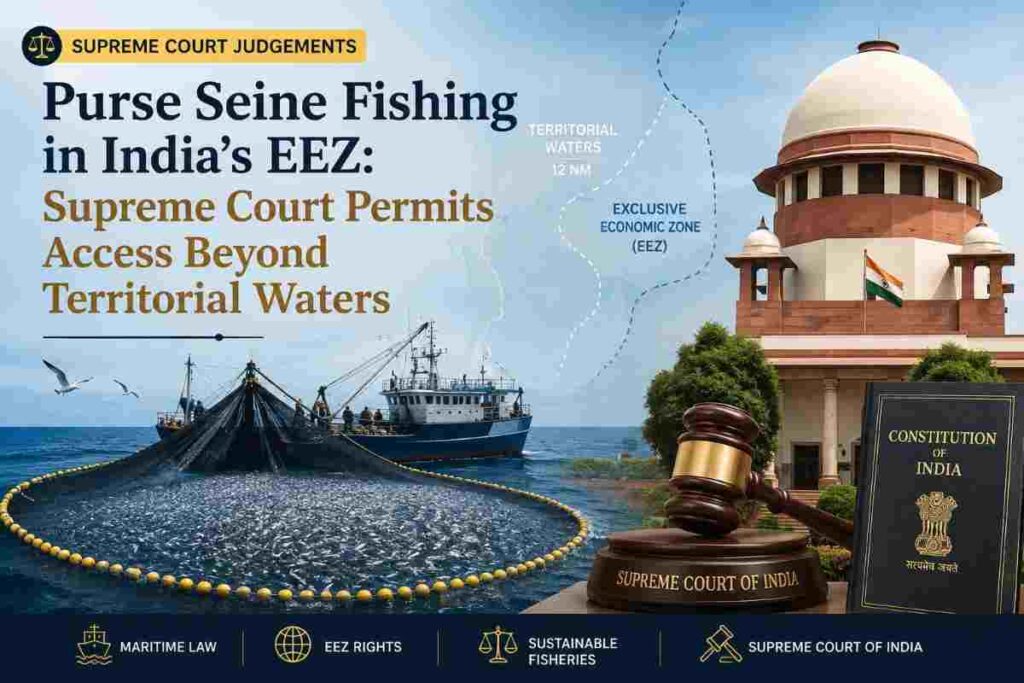

Case Citation: 2026 INSC 937 | Date: September 2, 2026 | Fisherman Care v. Union of India
Introduction
After decades of restrictions, India’s Supreme Court has finally opened doors for fishermen to use purse seine nets in the Exclusive Economic Zone (EEZ) — but with a significant catch. In a landmark 2026 judgment, the Court resolved the bitter dispute between Tamil Nadu’s blanket prohibition on purse seine fishing and the constitutional rights of fishing communities to access the nation’s marine resources. This judgment represents a watershed moment in India’s fisheries law, striking a balance between environmental sustainability and the livelihoods of thousands of fishermen. The decision is not just a legal victory; it signals a fundamental shift in how India regulates fishing beyond its territorial waters and demonstrates the Supreme Court’s commitment to cooperative federalism. If you’re involved in fishing, maritime law, environmental policy, or Indian administrative law, this judgment reshapes your legal landscape.
Case Details
| Particular | Details |
|---|---|
| Case Name | Fisherman Care v. The Government of India Department of Animal Husbandry, Dairying and Fisheries; Gnanasekar and Ors v. Union of India |
| Court | Supreme Court of India |
| Judgment Date | September 2, 2026 |
| Bench | Justice Pamidighantam Sri Narasimha & Justice Alok Aradhe |
| Case Citation | 2026 INSC 937; I.A. No. 190882/2024 in WP(C) No. 262 of 2022 |
| Statutory Provisions | Tamil Nadu Marine Fishing Regulation Act, 1983; Territorial Waters, Continental Shelf, EEZ Act, 1976; Marine Fishing Regulation Rules, 2020; Sustainable Harnessing of Fisheries in EEZ Rules, 2025; Constitution of India (Articles 19(1)(g), List I Entry 57, List II Entry 21) |
Background and Facts of the Case
The dispute originates in 1983, when Tamil Nadu enacted the Marine Fishing Regulation Act to conserve marine biodiversity. The central provision that sparked decades of litigation was Government Order (G.O.) MS No. 40 dated March 25, 2000, which imposed an absolute prohibition on fishing using purse seine nets in all coastal areas of Tamil Nadu within territorial waters (up to 12 nautical miles). The State justified this ban as a conservation measure to protect juvenile fish stocks.
However, fishermen in Tamil Nadu and other coastal states use purse seine nets extensively. These nets, which function like drawstring bags to encircle fish schools, are highly effective but have raised ecological concerns in some quarters. For decades, fishing communities operated largely within the territorial waters. But a new issue emerged: could they legally transit through Tamil Nadu’s territorial waters to fish in the Exclusive Economic Zone (EEZ) — the maritime region extending 200 nautical miles from the coast where India has sovereign fishing rights but where international law permits ‘innocent passage’?
When fishermen began seeking permission to transit through territorial waters with purse seine nets to access the EEZ, Tamil Nadu authorities denied permission, arguing that Rule 17(7) of the Marine Fishing Regulation Rules, 2020, prohibited even ‘carrying’ purse seine nets in a fishing vessel anywhere within the State’s reach. This created a practical deadlock: fishermen could not legally reach the EEZ to fish, even though the EEZ itself was theoretically open to them.
Legal Issues Before the Court
The Court distilled the central legal conflict into distinct but interrelated issues:
1. Territorial Jurisdiction vs. Exclusive Economic Zone Rights: Does a State have the constitutional power to regulate the ‘carrying’ of prohibited fishing gear within its territorial waters, even when the stated purpose is to fish in the EEZ where the State has no jurisdiction?
2. Federalism and Regulatory Boundaries: When Union and State laws operate in overlapping maritime zones, who determines access rights? Can cooperative federalism reconcile both regimes?
3. Constitutional Rights vs. Conservation: Can environmental conservation justify restricting citizens’ fundamental right to profession (Article 19(1)(g)) without clear evidence of harm?
4. Practical Implementation: How do regulatory authorities balance the competing interests of coastal conservation and international maritime law principles of innocent passage?
Arguments of the Parties
Petitioners’ Arguments (Fishermen)
The fishermen argued that:
• The EEZ lies entirely beyond Tamil Nadu’s territorial jurisdiction. No State has authority to regulate activities in the EEZ under the Indian Constitution; this power vests exclusively with the Union under Entry 57 of List I.
• Merely transiting through territorial waters to reach the EEZ should not be equated with fishing within the State’s regulated area. The State’s conservation mandate does not extend to controlling vessels in transit.
• No scientific evidence demonstrates that purse seine nets cause harm when used in the EEZ. The blanket ban was based on outdated assumptions and violates their constitutional right to practice their profession.
State of Tamil Nadu’s Arguments
Tamil Nadu countered that:
• Rule 17(7) explicitly prohibits ‘carrying’ purse seine nets in any fishing vessel within the State, regardless of intent. This is a blanket restriction on the gear itself, not merely on fishing.
• Fishermen cannot credibly be monitored while in territorial waters. Under the guise of transiting to the EEZ, they could deploy nets within 12 nautical miles, evading State regulation and undermining conservation efforts.
• The State’s legislative competence under Entry 21 of List II includes protecting fishery resources within its jurisdiction. A ban is a reasonable conservation measure even if it incidentally affects passage to the EEZ.
Court’s Analysis and Reasoning
The Supreme Court’s reasoning proceeded on multiple levels, each addressing a distinct constitutional principle:
1. Federalism and Divided Legislative Competence
The Court emphasized a foundational principle from the Constituent Assembly debates (citing Dr. B.R. Ambedkar): the Union and States are co-equal authorities within their respective legislative domains. Entry 57 of List I grants Parliament exclusive power over fisheries ‘beyond territorial waters,’ while Entry 21 of List II vests State power over fisheries ‘within territorial waters.’ These are not hierarchical but ‘autonomous’ spheres.
Critically, the Court found no conflict between the EEZ Rules, 2025 (Union’s domain) and the Marine Fishing Regulation Rules, 2020 (State’s domain). The conflict arose not from the laws themselves but from their practical implementation by authorities.
2. Expert Committee Report and Scientific Assessment
The Court had earlier ordered an Expert Committee (in 2022) to examine whether purse seine nets pose environmental harm. The interim report (November 15, 2022) concluded: “Given the facts elaborated above, a ban on purse seine fishing is not justified, and may be allowed (in the TW and EEZ of India) subject to conditions.”
The final Expert Committee report (May 31, 2024) reinforced this, recommending that access to the EEZ should be granted via an annual permit system based on scientific criteria (fleet size, vessel age, mesh size regulations) rather than a categorical ban. The Committee also recommended standardization of boat specifications and mandatory Vessel Monitoring Systems (VMS) for safety and stock management.
By relying on expert evidence, the Court rejected speculation and placed the burden on conservation advocates to prove harm, not on fishermen to disprove it.
3. Cooperative Federalism and Article 19(1)(g)
The Court invoked the doctrine of ‘cooperative federalism’ to resolve the impasse. Both the Union and State are not just duty-bearers to implement their respective laws but are also duty-bearers to ‘ensure that stakeholders have easy access and efficient clearance of their applications to pursue their fundamental rights under Article 19(1)(g) of the Constitution.’
This was groundbreaking: the Court did not simply strike down the State’s rules but directed both levels of government to work in tandem. The Union establishes the overall permit system for the EEZ (via EEZ Rules, 2025), while the State facilitates transit through territorial waters without imposing its own independent restrictions on purpose.
4. International Law and Innocent Passage
While not explicitly elaborated, the Court’s direction to frame rules for ‘specified channels’ and the references to international permit systems reflect an understanding of the law of the sea. Vessels have a customary international law right of innocent passage through territorial waters to reach the EEZ. The Court steered the State toward facilitating this principle rather than thwarting it.
The Judgment and Final Decision
The Court disposed of I.A. No. 190882/2024 (which effectively resolved the entire batch of petitions) with the following order:
1. The rights and liabilities of all parties are now governed by:
- The Sustainable Harnessing of Fisheries in the EEZ Rules, 2025 (Union law) for fishing in the EEZ
- The Tamil Nadu Marine Fishing Regulation Rules, 2020 (State law) for activities within territorial waters
2. The State Government must frame necessary rules/regulations designating a specified channel (under Rules 15(5) and (6) of the Marine Fishing Regulation Rules, 2020) to permit transit of purse seine fishing vessels from its territorial waters to the EEZ. This channel designation must incorporate the Expert Committee’s recommendations.
3. The State must ensure ‘effective, efficient and timely clearance’ of Access Pass applications under the EEZ Rules, 2025. As of August 3, 2026, only 6 out of 257 Access Pass applications from Tamil Nadu had been issued (the lowest among all coastal States). The Court noted that “not processing applications in time virtually amounts to imposing an unwritten ban, which is impermissible in law.”
Ratio Decidendi (Core Legal Principle)
The ratio decidendi of this judgment can be distilled as follows:
Where Union and State laws operate in distinct constitutional domains (e.g., EEZ and territorial waters), neither authority can instrumentalize its power to functionally nullify the other’s authority. A State may regulate fishing methods within its territorial waters on environmental grounds, but may not use this power to regulate activities beyond its jurisdiction (EEZ) or to prevent innocent transit of vessels to areas of Union jurisdiction. Conversely, the Union must ensure that State concerns about enforcement and compliance are addressed through cooperative mechanisms (designated channels, VMS, reporting) rather than dismissing them. This principle reflects constitutional federalism where powers are ‘co-equal and autonomous,’ not subordinate.
Important Statutory Provisions Explained
1. Tamil Nadu Marine Fishing Regulation Act, 1983 – Sections 3(k), 5, 7
Section 3(k) defines ‘specified area’ as the sea along the coastline but ‘not beyond territorial waters.’ This was crucial because it meant the original legislative intent was to regulate only within the State’s jurisdiction. Yet, the 2000 G.O. and 2020 Rules arguably over-read this authority by prohibiting the mere carrying of gear.
2. Marine Fishing Regulation Rules, 2020 – Rules 15 and 17
Rule 15(5) and (6) establish ‘specified channels’ for mechanized vessels to transit from their berthing points through coastal waters. The Court leveraged these provisions to direct the State to extend such channels for purse seine vessels transiting to the EEZ, showing that the procedural framework already existed; the State merely needed to apply it.
Rule 17(7) prohibited carrying purse seine nets ‘in the entire coastal area of the State.’ The Court implicitly read this as applying only to fishing within the coastal area, not to transit with intent to fish elsewhere.
3. Territorial Waters, Continental Shelf, EEZ and Other Maritime Zones Act, 1976 – Section 7(1)
This Act grants the Union government power to frame rules for fishing in the EEZ. The Court acknowledged that the Union exercised this power by notifying the EEZ Rules, 2025 on November 4, 2025. This was the Union’s response to fill the regulatory vacuum that had persisted for decades.
4. Sustainable Harnessing of Fisheries in the EEZ Rules, 2025
Issued on November 4, 2025, these Rules introduced:
• ‘Access Pass’ system: Issued by Deputy Director-level officers in the Department of Fisheries (Rule 2(1)(a), (j)).
• Criteria-based approach: Unlike the State’s blanket ban, the Union Rules allow access based on standardized criteria (boat size, engine power, gear specifications, vessel age).
• Mandatory VMS and catch reporting (Rules 12, 13): This directly addresses the State’s concern about monitoring compliance.
• Fisheries management plan and national action plan against illegal fishing (Rules 8, 14, 15): These provide the scientific framework Tamil Nadu lacked.
5. Constitution of India – Articles 19(1)(g), List I Entry 57, List II Entry 21
Article 19(1)(g) guarantees the right to practice any profession. This is not absolute but subject to ‘reasonable restrictions.’ The Court found that a blanket ban without scientific justification was unreasonable.
Entry 57 of List I (Union domain): ‘Fishing and fisheries beyond territorial waters.’ Entry 21 of List II (State domain): ‘Fisheries.’ The Court clarified that these entries do not overlap in a conflictual way if properly administered.
Important Precedents Relied Upon
| Case | Legal Principle | How It Was Used |
|---|---|---|
| Constituent Assembly Debates, Vol. 11 (Dr. B.R. Ambedkar, 25 Nov 1949) | Centre and States are co-equal, autonomous authorities within their respective legislative spheres; not hierarchical. | Foundation for resolving the federalism issue; supported the Court’s refusal to see Union-State conflict. |
| Union of India And Anr. v. Mohit Minerals Private Ltd., (2022) 10 SCC 700 | Cooperative federalism requires Centre and States to work harmoniously to achieve constitutional objectives. | Invoked to support the duty of both Union and State to facilitate stakeholders’ access to their rights. |
| State of Kerala v. Joseph Antony, (1994) 1 SCC 301 | Federalism and allocation of powers between Centre and States in maritime matters. | Used to establish that maritime regulation is divided, not unified, between the two levels. |
| Kerala Swathanthra Malaya Thozhilali Federation v. Kerala Trawlnet Boat Operators’ Association, (1994) 5 SCC 28 | Principle of interpreting fisheries regulations to protect both labour and conservation interests. | Demonstrated that prior Courts have balanced fishery regulations with rights of workers. |
What This Judgment Means
For Fishing Communities and Fishermen
This judgment is a major relief. For the first time, fishermen have a clear legal right to transit through Tamil Nadu’s territorial waters with purse seine nets to access the EEZ, provided they obtain an Access Pass under the Union’s EEZ Rules, 2025. The judgment removes the legal ambiguity that had paralyzed the fishing industry. However, it is not a free-for-all: fishermen must comply with the Union’s standards (VMS installation, catch reporting, designated landing centres), and the State will have designated channels and conditions for transit. The practical implementation now depends on how quickly Tamil Nadu processes the backlog of 226 pending Access Pass applications.
For State and Local Governments
The State of Tamil Nadu is no longer permitted to unilaterally block access to the EEZ, even on environmental grounds. However, the judgment respects the State’s interest in monitoring compliance and protecting coastal ecosystems. Tamil Nadu must now work constructively with the Union to establish designated channels, coordinate with Coast Guard and Marine Police, and process permits efficiently. The Court’s rebuke about 226 pending applications signals that the State’s implementation has fallen short and corrective action is required.
For Central Government and Fisheries Administration
The Union now has a clear framework (EEZ Rules, 2025) but must ensure it is implemented effectively. The establishment of a ‘nodal agency’ for a centralized national permit system is critical. The Union must also ensure that the expert committee’s recommendation for Vessel Monitoring Systems, catch declaration systems, and minimum legal size regulations are enforced uniformly across all coastal states, not just Tamil Nadu.
For Environmental and Fisheries Policy
This judgment prioritizes science over precaution. The Expert Committee’s conclusion that purse seine fishing does not warrant an outright ban — but does require regulation — becomes binding policy. Future restrictions on fishing gear must be backed by evidence, not speculation. This sets a precedent for how fisheries regulations across India should be framed.
For International Maritime Law in India
Implicitly, the judgment respects the principle of innocent passage — a cornerstone of the UN Convention on the Law of the Sea (UNCLOS), to which India is a signatory. Vessels have a customary right to transit through territorial waters to reach the EEZ. This judgment aligns Indian domestic law with international maritime norms.
Key Takeaways
- Purse seine fishing is now permitted in India’s EEZ, subject to an Access Pass system and compliance with Union rules on VMS, catch reporting, and boat specifications.
- States cannot prohibit fishing gear in territorial waters merely to regulate the EEZ; the distinction between the two jurisdictions is constitutionally sacrosanct.
- Environmental regulations must be grounded in scientific evidence. The Expert Committee’s interim and final reports became the basis for overriding Tamil Nadu’s 26-year-old blanket ban.
- Cooperative federalism is not merely an aspirational principle; it is a binding obligation on both Centre and States to facilitate citizens’ fundamental rights through timely and efficient administration.
- The judgment reveals a systemic failure: Tamil Nadu had processed only 6 out of 257 Access Pass applications by August 2026. The Court’s directive to process applications efficiently addresses this administrative bottleneck.
- VMS (Vessel Monitoring Systems) and catch declaration systems are now mandatory frameworks for monitoring compliance and preventing illegal fishing.
- The ratio establishes that a State may regulate fishing methods within its jurisdiction but cannot use regulatory power to functionally nullify Union jurisdiction beyond territorial waters.
- Article 19(1)(g) rights to profession are subject to reasonable restrictions; unreasonable blanket bans without evidence are unconstitutional.
- Designated channels for transit of fishing vessels through territorial waters are now mandatory in Tamil Nadu, incorporating expert committee recommendations.
- This judgment is likely to become a template for resolving similar disputes in other coastal states (Kerala, Karnataka, Andhra Pradesh, Odisha, Gujarat) that may have purse seine restrictions.
Frequently Asked Questions (FAQs)
Q1: Can fishermen now freely use purse seine nets everywhere in India?
A: No. Fishermen can use purse seine nets in the EEZ (beyond 12 nautical miles) subject to an Access Pass from the Union’s Department of Fisheries. Within territorial waters (0-12 nautical miles), State laws still apply. In Tamil Nadu, the State may restrict purse seine fishing within territorial waters but must facilitate transit through a designated channel.
Q2: What is an Access Pass, and how do fishermen obtain one?
A: An Access Pass is issued by the Union Government (via a Deputy Director in the Department of Fisheries) under the Sustainable Harnessing of Fisheries in the EEZ Rules, 2025. To obtain one, a fishing vessel must meet criteria such as: registration under the Marine Products Export Development Authority Act, 1972; installation of an approved Vessel Monitoring System (VMS); compliance with boat size, engine power, and gear specifications; and filing an application via the ReALCRaft Portal.
Q3: Does the Fisherman Care judgment overrule Tamil Nadu’s purse seine ban?
A: Partially. The judgment does not strike down the ban within territorial waters (the State’s authority is upheld). However, it prohibits the State from using the ban to block access to the EEZ. The State must create a designated channel and allow permitted vessels to transit. The State may still regulate fishing methods within its waters for conservation purposes, but such regulations cannot be used extraterritorially.
Q4: What is a Vessel Monitoring System (VMS), and is it mandatory?
A: VMS is a GPS-based tracking system that records a vessel’s location in real-time. Yes, it is mandatory for all vessels fishing in the EEZ under the EEZ Rules, 2025. The VMS codes must be provided to the Fisheries Department, Marine Police, Coast Guard, and Indian Navy. This allows authorities to verify that vessels operate only in permitted areas and at permitted times.
Q5: Why was the Expert Committee report so important?
A: The Expert Committee’s report provided scientific evidence that purse seine nets do not cause major environmental harm warranting an outright ban. This shifted the burden of proof: instead of fishermen proving nets are safe, Tamil Nadu had to justify the ban scientifically. Since no such evidence existed, the ban was indefensible. The report became the factual foundation for the Court’s reasoning.
Q6: What does ‘cooperative federalism’ mean in this context?
A: Cooperative federalism means that when Union and State powers overlap or touch (e.g., fishing in territorial waters and EEZ), both must work together to achieve the objective — in this case, allowing fishermen to exercise their rights while respecting legitimate State conservation interests. It requires the State to process Union permits efficiently and the Union to ensure rules account for State concerns.
Q7: What will happen to the 226 pending Access Pass applications in Tamil Nadu?
A: The Court has directed Tamil Nadu to process them efficiently and timely. The State Verifying Officer (designated by the State Government) must verify documents and conduct physical inspections of fishing vessels and must issue or reject the Pass within a reasonable timeframe. Non-processing amounts to imposing an ‘unwritten ban,’ which is impermissible.
Q8: Can other coastal states like Kerala or Karnataka also restrict purse seine fishing?
A: Yes, States can restrict purse seine fishing within their territorial waters if they have scientific or regulatory justification. However, they cannot use such restrictions to prevent access to the EEZ. If they do, fishermen can challenge the restriction in court using this judgment as precedent. The judgment essentially requires all States to allow designated channels for transit to the EEZ.
Q9: What is the ‘ratio decidendi’ of this case, and why does it matter?
A: The ratio is the core legal principle: Union and State laws in their respective domains are co-equal; one cannot be used to functionally nullify the other. Future courts will apply this principle to resolve similar federalism disputes. Lawyers can cite this as binding precedent for challenges to State regulations that extraterritorially affect Union powers.
Q10: Does this judgment affect fish conservation or environmental protection?
A: The judgment does not ignore conservation; it channels it through science-based mechanisms. Instead of blanket bans, it mandates fisheries management plans, catch monitoring, juvenile fish protection measures (mesh size regulation, minimum legal size rules), and prevention of illegal fishing. These are arguably more effective than a simple ban.
Q11: What if a fisherman operates beyond the EEZ or violates the Access Pass conditions?
A: The EEZ Rules, 2025 provide for penalties and enforcement. If a vessel is tracked (via VMS) operating beyond the EEZ or in restricted areas, or if it violates catch reporting or landing requirements, the Union Government can suspend or revoke the Access Pass. The vessel may also face prosecution under maritime laws.
Q12: When will the designated channel for transit in Tamil Nadu be notified?
A: The judgment directs Tamil Nadu to frame rules and notify the designated channel ‘after taking into account the final recommendations of the Expert Committee.’ There is no specific deadline, but given the Court’s criticism of the State’s slow application processing, it is expected to be done expeditiously. Fishermen or the Union can move for implementation if the State delays unreasonably.
Conclusion
The Fisherman Care judgment represents a watershed in Indian maritime and constitutional law. By grounding its decision in scientific evidence rather than speculation, invoking cooperative federalism as a binding principle, and carefully demarcating Union and State powers in the maritime domain, the Supreme Court has provided a template for resolving future disputes between environmental regulation and economic rights.
The judgment is not a victory for unfettered fishing; it is a victory for rule-of-law governance. Regulation is retained, but it is evidence-based, transparent, and fair. Fishermen have clear pathways to compliance (Access Passes, VMS, catch reporting), and authorities have tools to monitor and enforce (designated channels, real-time tracking, mandatory landing centres).
For lawyers, legal scholars, and policy makers, this judgment is essential reading on constitutional federalism, maritime administration, and the evolution of India’s fisheries law. For fishermen and their families, it offers hope that decades of injustice may finally give way to prosperity.



Pingback: Criminal Law: Acquittal for Lack of Evidence - Supreme Court Sets Aside Murder Conviction (Dhrub Singh v. State of Bihar, 2026 INSC 935) - Lexhub