

Introduction
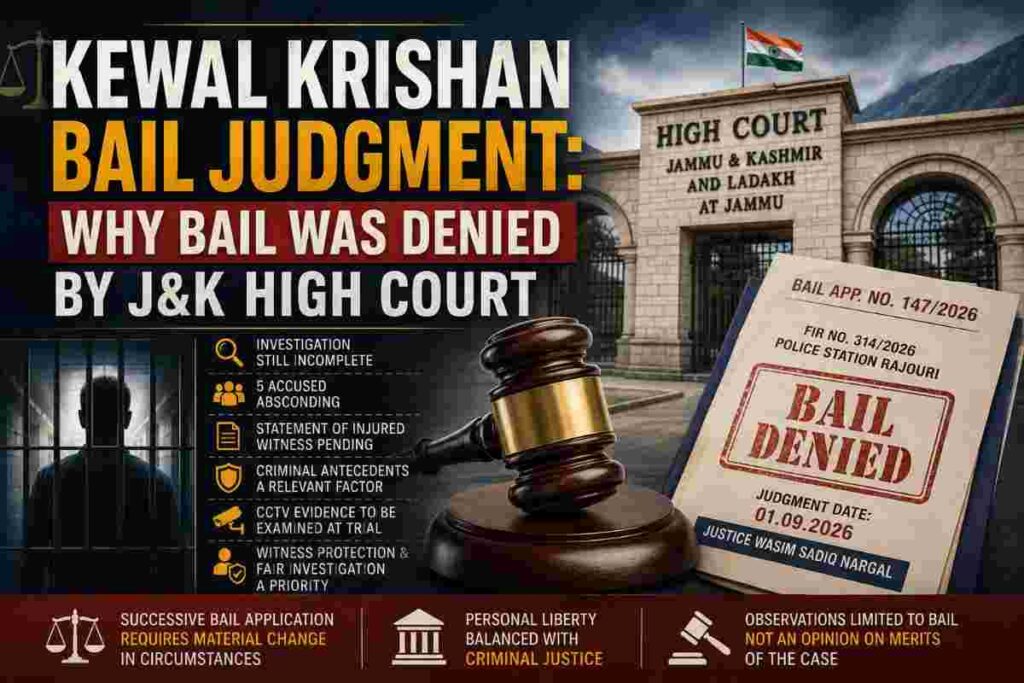
The Jammu & Kashmir and Ladakh High Court has refused to grant regular bail to Kewal Krishan in Bail App. No. 147/2026, holding that the circumstances relied upon by the applicant did not constitute a sufficient material change to justify release at the stage of investigation.
The case arose from FIR No. 314/2026, registered at Police Station Rajouri for offences under Sections 109, 126(2) and 191(2) of the Bharatiya Nyaya Sanhita, 2023 (BNS) and Sections 4/25 of the Arms Act, 1959. The judgment was pronounced on 1 September 2026 by Justice Wasim Sadiq Nargal.
The judgment is particularly relevant for understanding successive bail applications, the significance of an ongoing investigation, criminal antecedents, suppression of material facts, witness protection and the limited examination of evidence at the bail stage.
Case Details
| Particular | Details |
|---|---|
| Case Name | Kewal Krishan v. UT of Jammu & Kashmir & Anr. |
| Court | High Court of Jammu & Kashmir and Ladakh at Jammu |
| Case Number | Bail App. No. 147/2026 |
| Judgment Date | 1 September 2026 |
| Bench | Justice Wasim Sadiq Nargal |
| FIR | FIR No. 314/2026 |
| Police Station | Rajouri |
| BNS Sections | Sections 109, 126(2), 191(2) |
| Arms Act | Sections 4/25 |
| Result | Regular bail dismissed |
The applicant had been in custody since 15 June 2026.
Background and Facts of the Case
According to the prosecution case, the incident occurred on 12 June 2026 at approximately 9:20 p.m. The complainant alleged that the victims were intercepted while returning from their shop and were attacked by several persons using hockey sticks, sharp-edged weapons and other weapons.
The complainant further alleged that one of the injured persons, Nikhil Bakshi, had been attacked approximately two months earlier by a group of 15–16 persons. Some of the persons allegedly involved in that earlier incident were also accused in the present case. The complainant alleged that threats had continued after the earlier incident.
The prosecution maintained that the investigation was still incomplete. Five accused persons were allegedly absconding, the statement of injured Nikhil Bakshi had not yet been recorded, medical reports concerning his injuries were awaited and the alleged weapons had not yet been recovered.
Why Did Kewal Krishan Seek Bail?
The applicant had previously approached the Principal Sessions Judge, Rajouri, for regular bail. That application was rejected on 11 July 2026, primarily because the injured persons were still undergoing treatment in Ludhiana.
For the subsequent bail application, the applicant argued that circumstances had changed because the injured persons had been discharged from the hospital. He therefore contended that the principal reason for the earlier rejection of bail no longer existed.
The applicant also relied upon CCTV footage from his petrol pump, claiming that it showed him continuously present there at the relevant time and therefore supported his claim that he was not present at the place of occurrence.
He further argued that no specific overt act had been attributed to him and that no recovery had been made from him. He submitted that continued pre-trial incarceration should not become punitive in nature.
What Was the Prosecution’s Objection?
The State opposed bail primarily on the ground that the investigation was still underway.
According to the prosecution, several accused persons remained absconding and the recovery of the weapons was still pending. The statement of injured Nikhil Bakshi had also not been recorded, and his medical reports were awaited.
The complainant additionally opposed bail on the basis of the alleged seriousness of the attack, the applicant’s criminal antecedents and the possibility of witnesses being influenced or intimidated.
A further issue arose because the applicant had disclosed two previous FIRs in his bail application, whereas the prosecution’s status report referred to a third FIR, FIR No. 35/2024. The applicant’s counsel stated that he was unaware of that FIR.
Legal Issues Before the High Court
The judgment essentially required the Court to consider:
- Whether a successive bail application was maintainable in the circumstances of the case.
- Whether there had been a material change in circumstances after rejection of the earlier bail application.
- Whether the stage of investigation justified continued custody.
- What significance should be attached to the applicant’s criminal antecedents and alleged incomplete disclosure of those antecedents.
- Whether the CCTV footage could justify bail at the investigation stage.
- Whether there was a reasonable apprehension of interference with witnesses or investigation.
What Is the Rule for a Successive Bail Application?
A successive bail application is not barred merely because an earlier application was rejected. However, the applicant must ordinarily demonstrate a material change in circumstances that could justify reconsideration.
The High Court emphasized that the Court dealing with the subsequent application must consider the reasons for rejection of the earlier application and determine whether there has been a substantial change in the factual or legal position. Simply repeating grounds that were previously rejected is insufficient.
Discharge from Hospital Was Not Enough
The applicant argued that the injured persons had been discharged and therefore the basis for the earlier bail rejection had disappeared.
The High Court, however, found that the latest status report showed that the statement of injured Nikhil Bakshi was still pending and his medical reports had not yet been received.
Consequently, the Court held that the circumstances relevant to the earlier rejection had not completely lost their relevance. The claimed change in circumstances therefore did not, by itself, justify granting bail.
Investigation Stage Was a Major Factor
The Court placed considerable importance on the fact that the investigation was still at a relatively early stage.
Five accused persons were stated to be absconding. The statement of one injured person was pending. Medical reports were awaited, and the alleged weapons had not been recovered.
The Investigating Agency had, however, collected witness statements, analysed call detail records, seized the vehicle allegedly connected with the occurrence and continued investigation.
The High Court therefore concluded that the prosecution’s apprehensions concerning interference with the investigation could not, at that stage, be dismissed as merely vague or speculative.
Criminal Antecedents and Suppression of Facts
Another important aspect of the judgment concerned the applicant’s criminal antecedents.
The status report referred to three earlier FIRs involving the applicant. The bail application, however, had disclosed only two earlier FIRs. The applicant explained that he was not aware of the third FIR.
The Court did not consider it necessary at that stage to conclusively determine whether the omission was deliberate. Nevertheless, it held that the bail application did not contain complete disclosure of the criminal cases reported by the Investigating Agency. This incomplete disclosure was treated as an additional circumstance weighing against the applicant.
The Court relied upon the Supreme Court’s decision in Zeba Khan v. State of U.P. & Ors., 2026 INSC 144, emphasizing the obligation of a person seeking bail to make a full and candid disclosure of material facts, including relevant criminal antecedents.
Can Criminal Antecedents Affect Bail?
Yes. The High Court treated criminal antecedents as one of the relevant factors in determining whether discretionary bail should be granted.
Relying upon Neeru Yadav v. State of U.P., (2016) 15 SCC 422, the Court emphasized that criminal history cannot simply be ignored while exercising bail discretion, particularly where the allegations in the current case are serious.
However, the judgment does not suggest that the existence of previous cases automatically bars bail. Rather, antecedents form part of the overall assessment alongside the nature of the allegations, investigation stage, possibility of witness interference and other relevant circumstances.
What About the CCTV Footage?
The applicant relied heavily on CCTV footage from his petrol pump to support an alibi.
The High Court did not conclusively reject the CCTV footage. Instead, it held that determining its evidentiary value, authenticity, continuity and ultimate effect on the prosecution case would require appreciation of the complete evidence.
Such detailed appreciation was considered inappropriate at the bail stage. The Court therefore left the ultimate effect of the CCTV footage to be examined during trial.
This reflects an important distinction: a bail court may consider prima facie material, but it is generally not expected to conduct a detailed trial-like examination of evidence.
Supreme Court Principles Relied Upon by the High Court
The High Court referred to several Supreme Court decisions concerning bail.
| Supreme Court Case | Principle | Use in Present Case |
|---|---|---|
| State through CBI v. Amarmani Tripathi, (2005) 8 SCC 21 | Nature of accusation, prima facie case, punishment, flight risk, antecedents and witness tampering are relevant | Used to identify the governing bail factors |
| Prasanta Kumar Sarkar v. Ashis Chatterjee, (2010) 14 SCC 496 | Bail discretion must be exercised judiciously and cautiously | Supported the need for reasoned bail consideration |
| Neeru Yadav v. State of U.P., (2016) 15 SCC 422 | Criminal antecedents are relevant to bail discretion | Applied to the applicant’s antecedents |
| Mahipal v. Rajesh Kumar @ Polia, (2020) 2 SCC 118 | Detailed evidence appreciation is not required at bail stage | Applied to CCTV and prima facie assessment |
| Brijmani Devi v. Pappu Kumar, (2022) 4 SCC 497 | Personal liberty must be balanced against serious accusations and other relevant factors | Used in balancing liberty and criminal justice |
| Manik Madhukar Sarve v. Vitthal Damuji Meher, (2024) 10 SCC 753 | Nature of accusation, role, tampering, antecedents and flight risk are relevant | Reinforced the cumulative bail assessment |
| Zeba Khan v. State of U.P. & Ors., 2026 INSC 144 | Applicants seeking bail should candidly disclose material facts | Applied to incomplete disclosure of antecedents |
The judgment expressly relied upon these authorities in developing its approach to bail.
Court’s Analysis: Liberty vs. Fair Investigation
The High Court acknowledged that personal liberty is a valuable constitutional right. At the same time, bail is not to be granted mechanically.
The Court considered several factors cumulatively:
- seriousness and manner of the alleged occurrence;
- prima facie material collected during investigation;
- criminal antecedents;
- incomplete investigation;
- absconding co-accused;
- pending examination of an injured person;
- pending recovery of alleged weapons;
- apprehension of witness intimidation or interference; and
- incomplete disclosure of criminal antecedents.
The Court emphasized that the bail inquiry is different from the trial. At this stage, the Court is not required to determine guilt beyond reasonable doubt. It must instead assess whether a prima facie case exists and whether continued custody is justified in the circumstances.
Final Judgment: Bail Application Dismissed
After considering the totality of circumstances, the Jammu & Kashmir and Ladakh High Court dismissed Kewal Krishan’s application for regular bail.
The Court concluded that there had not been a sufficient material change from the circumstances considered at the time of the earlier bail application. The investigation remained incomplete, five accused persons were still absconding, the statement of one injured person was pending, medical material was awaited, and the alleged weapons had not been recovered.
The applicant’s antecedents and incomplete disclosure were additional factors against granting bail.
Importantly, the Court clarified that its observations were confined to the adjudication of the bail application and should not be treated as an opinion on the merits of the prosecution case. The trial court was directed to consider the case independently on the evidence produced before it.
Ratio Decidendi
The central principle emerging from the judgment is that a successive bail application requires consideration of the circumstances that led to rejection of the earlier application and ordinarily requires a material change in the factual or legal position.
Where the investigation remains at an early stage, material witnesses have yet to be examined, recoveries remain pending and there are credible concerns regarding interference with witnesses or investigation, the Court may decline bail even where the applicant relies on circumstances such as discharge of injured persons from hospital.
The judgment also reinforces that criminal antecedents and incomplete disclosure of material facts can legitimately influence the exercise of judicial discretion in bail matters.
What Does This Judgment Mean for Lawyers and Litigants?
For accused persons
A subsequent bail application should not merely repeat arguments already rejected. Counsel should identify and demonstrate a genuine change in circumstances.
Applicants should also ensure complete and accurate disclosure of relevant criminal antecedents.
For defence lawyers
The judgment highlights the importance of addressing the precise reason for rejection of an earlier bail application. If the previous order was based on a particular factual circumstance, the subsequent application should establish why that circumstance has materially changed.
For prosecution
The prosecution must demonstrate concrete circumstances supporting continued custody rather than relying solely on generalized apprehensions. In this case, the Court found that the pending investigation, absconding accused, pending witness statement and recovery issues provided relevant circumstances.
For law students and judiciary aspirants
The judgment provides a useful illustration of the difference between:
Prima facie assessment at the bail stage
and
Detailed appreciation of evidence at trial.
It also provides a practical framework for studying successive bail applications and the factors governing bail discretion.
Key Takeaways
- A successive bail application is maintainable, but a material change in circumstances is important.
- Merely repeating grounds rejected in an earlier bail application is insufficient.
- The stage and progress of investigation are important considerations.
- Pending examination of an injured witness may weigh against bail.
- Pending recovery of alleged weapons can be relevant.
- Criminal antecedents may influence the exercise of bail discretion.
- Applicants seeking bail should make complete and candid disclosure of material facts.
- Courts need not conduct a detailed examination of CCTV or other evidence at the bail stage.
- Personal liberty must be balanced against the interests of a fair investigation and administration of criminal justice.
- Findings at the bail stage should not be treated as findings on the ultimate merits of the criminal case.
Frequently Asked Questions
What is the Kewal Krishan bail judgment?
It is a judgment of the Jammu & Kashmir and Ladakh High Court in Bail App. No. 147/2026, in which the Court dismissed Kewal Krishan’s application for regular bail in connection with FIR No. 314/2026 registered at Police Station Rajouri.
When was the Kewal Krishan judgment delivered?
The judgment was pronounced on 1 September 2026 by Justice Wasim Sadiq Nargal.
Why was bail denied to Kewal Krishan?
The Court relied cumulatively on the seriousness of the allegations, incomplete investigation, absconding co-accused, pending statement and medical reports, pending weapon recovery, criminal antecedents and incomplete disclosure of those antecedents.
What is a successive bail application?
A successive bail application is a subsequent request for bail after an earlier bail application has already been rejected. The Court must consider the reasons for the earlier rejection and whether circumstances have materially changed.
Can criminal antecedents affect bail?
Yes. Criminal antecedents are among the factors a court may consider while exercising its discretion in a bail application, particularly when considered alongside the nature of the present allegations and other circumstances.
Did the High Court reject the CCTV evidence?
No. The Court did not conclusively determine the value of the CCTV footage. It held that its authenticity, continuity, evidentiary value and effect on the prosecution case required consideration in light of the entire evidence and were better left for trial.
Does discharge of an injured person from hospital automatically justify bail?
No. In this case, the Court found that although the injured persons had been discharged, the statement of one injured person and relevant medical reports were still pending. Therefore, the circumstances underlying the earlier rejection had not completely disappeared.
What is the ratio decidendi of the judgment?
The principal principle is that a successive bail application should be supported by a material change in circumstances, while the Court may consider investigation status, criminal antecedents, witness protection and other established bail factors cumulatively.
Did the High Court decide Kewal Krishan’s guilt?
No. The Court expressly clarified that its observations were confined to the bail application and would not constitute an opinion on the merits of the prosecution case.