

Introduction
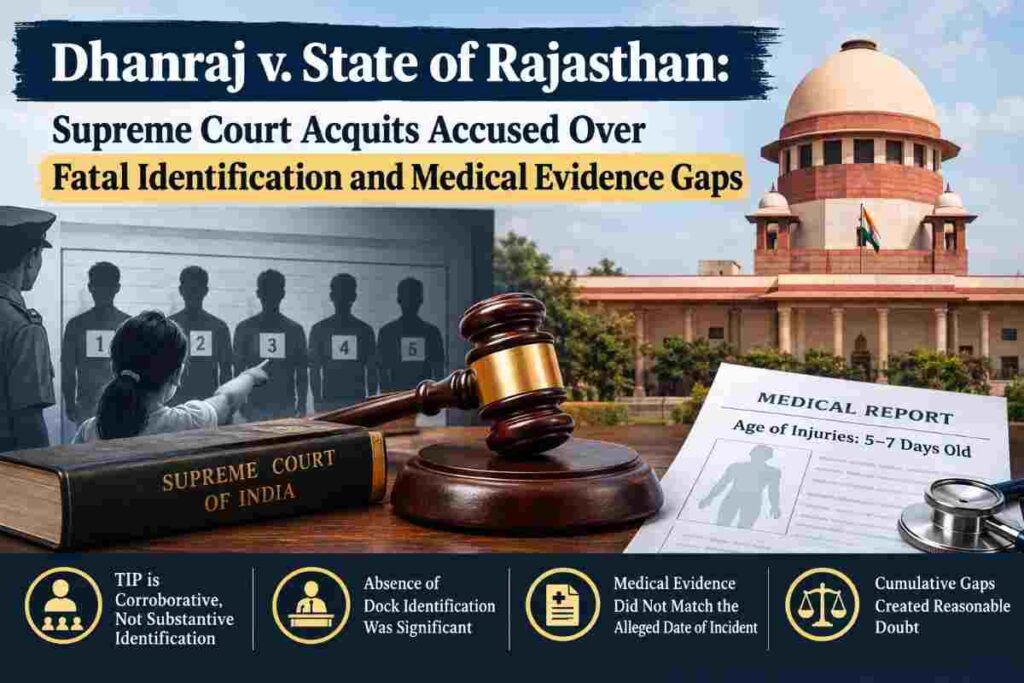
The Supreme Court of India has set aside the conviction of Dhanraj in a POCSO case arising from Rajasthan, holding that serious deficiencies in the prosecution’s evidence regarding the identity of the assailant and the timing of the alleged incident created reasonable doubt.
The case is significant not because the Court disputed that the child victim had suffered injuries associated with sexual assault, but because the prosecution failed to reliably establish that Dhanraj was the person who committed the offence. The Court particularly emphasised the distinction between identification during a Test Identification Parade (TIP) and identification made by a witness in court.
The Supreme Court also found a significant discrepancy between the medical evidence concerning the age of the injuries and the prosecution’s alleged date of occurrence. These defects, considered cumulatively, went to the root of the prosecution case.
The Court therefore set aside the judgments of the trial court and the Rajasthan High Court and acquitted the appellant.
Case Details
| Particular | Details |
|---|---|
| Case Name | Dhanraj v. State of Rajasthan |
| Court | Supreme Court of India |
| Jurisdiction | Criminal Appellate Jurisdiction |
| Case Number | Criminal Appeal No. 135 of 2026 |
| Judgment Date | 7 September 2026 |
| Bench | Justice Sandeep Mehta and Justice Manmohan |
| Appellant | Dhanraj |
| Respondent | State of Rajasthan |
| Trial Court | Special Judge, POCSO Act and Commission for Protection of Child Rights Act, 2005 No. 2, Ajmer |
| High Court Case | D.B. Criminal Appeal No. 338 of 2019 |
| Principal Offences for which conviction was recorded | Sections 376, 376(2)(i)(j), 363 and 323 IPC |
| Other charges in the charge-sheet | Sections 363, 366A, 323, 376, 376(2)(i)(j) IPC and Sections 3/4 and 5(m)/6 POCSO Act |
The trial court had sentenced the appellant to life imprisonment for the offences under Sections 376 and 376(2)(i)(j) IPC, seven years’ rigorous imprisonment under Section 363 IPC and one year’s simple imprisonment under Section 323 IPC.
Background and Facts of the Case
The prosecution case arose from an incident alleged to have occurred on 5 December 2016 in Ajmer district, Rajasthan.
The complainant’s wife had gone with their two children to attend a programme. When the complainant’s wife realised that their approximately five-year-old daughter was not with the family, the complainant returned to the village and joined the search.
The child was subsequently brought back by two persons who had encountered her. Her mother noticed bleeding from the child’s private parts. The family took her to a hospital but did not immediately approach the police because of embarrassment and concern about societal backlash.
According to the prosecution, the child told her parents that she had been taken towards the area near a higher secondary school, where a boy sexually assaulted her and threatened her when she attempted to raise an alarm.
An FIR was registered on 7 December 2016 against an unknown person for offences under Section 376 IPC and Sections 3/4 of the POCSO Act.
Dhanraj was arrested on 5 February 2017. During a Test Identification Parade, the child identified him as the assailant. Following investigation, a chargesheet was filed for several offences under the IPC and POCSO Act.
The trial court convicted Dhanraj. The Rajasthan High Court subsequently dismissed his appeal on 20 August 2025. Dhanraj then approached the Supreme Court.
What Were the Main Issues Before the Supreme Court?
The Supreme Court’s analysis principally concerned:
- Whether the prosecution had reliably established the identity of Dhanraj as the assailant.
- Whether the Test Identification Parade could sustain the identification case in the circumstances.
- Whether the absence of identification by the victim during her court deposition was fatal.
- Whether the medical evidence concerning the age of the injuries was consistent with the prosecution’s alleged date of occurrence.
- Whether the cumulative deficiencies in investigation and evidence created reasonable doubt.
- Whether the trial court had properly discharged its duty to ensure a fair and effective examination of material evidence.
Arguments of the Accused
The defence challenged the prosecution case on several grounds.
It argued that the accused had not been named in the FIR and that the victim had not provided identifying features of the assailant in her earliest statements.
The defence also emphasised that the victim did not identify Dhanraj during her sworn testimony in court, despite stating that she could identify him if he appeared before her.
Another important argument concerned the TIP. According to the defence, the police had disclosed Dhanraj’s name to the victim before the identification exercise. It was therefore argued that the TIP could not safely establish his identity.
The defence further pointed to the non-production of a sketch allegedly prepared with the assistance of the victim, as well as the absence of DNA or other scientific evidence connecting Dhanraj with the biological material recovered from the victim.
The appellant also relied upon defence evidence supporting his plea of alibi and false implication.
Arguments of the State
The State defended the conviction and argued that the prosecution had established guilt beyond reasonable doubt.
It relied upon the victim’s testimony, her identification of the accused during the TIP, the medical evidence and the surrounding circumstances.
The State argued that the victim was approximately five years old at the time of the incident and that minor discrepancies should not undermine her testimony. It also contended that the absence of DNA evidence could not by itself discredit otherwise reliable ocular and medical evidence.
Supreme Court’s Analysis and Reasoning
The FIR Did Not Identify the Assailant
The Supreme Court noted that the FIR was lodged two days after the alleged incident and accepted the family’s explanation for the delay.
However, the Court distinguished the delay in lodging the FIR from the contents of the FIR.
The FIR did not name the accused and did not contain particular identifying features that could have assisted the victim in identifying an unknown assailant later.
This became important because the prosecution subsequently relied heavily on the identification of Dhanraj.
Investigation Did Not Reliably Establish How Dhanraj Became a Suspect
The Court found the circumstances surrounding Dhanraj’s arrest questionable.
The Investigating Officer stated that the appellant was arrested on the basis of a source informer’s report, but the Court found no adequate foundation for that assumption.
The Court also noted that the accused and his family had complained of false implication at the behest of a local MLA. Although the Investigating Officer admitted receiving those complaints and affidavits, he did not conduct an inquiry into them.
According to the Supreme Court, this failure deprived the Court of potentially relevant circumstances that could have either supported or weakened the defence plea.
The Missing Sketch Was Significant
The investigation had apparently involved preparation of a sketch of the alleged assailant with the assistance of the victim.
However, the sketch was not produced before the trial court.
The Supreme Court considered this important because the sketch could have provided an objective means of comparing the description allegedly given by the victim at an early stage with the physical characteristics of the accused.
Its non-production therefore deprived the Court of an opportunity to test the consistency of the identification evidence.
Medical Evidence Created a Serious Problem Regarding the Date of the Incident
The medical evidence created another major difficulty.
The victim was examined on 7 December 2016. The doctor observed injuries and opined that they were approximately 5–7 days old.
The prosecution case, however, was that the incident occurred on 5 December 2016.
The Supreme Court found that this created a significant discrepancy. If the injuries were 5–7 days old on 7 December, the medical opinion did not match the alleged date of occurrence.
The Court further observed that the prosecution had not produced serological evidence, DNA profiling or other forensic evidence connecting the biological material to Dhanraj.
Medical evidence could establish injuries associated with sexual assault, but it did not, in the circumstances, establish the identity of the person responsible.
Why Was the Test Identification Parade Not Enough?
This is one of the most important legal principles emerging from the judgment.
The Supreme Court reiterated that identification made by a witness in court constitutes substantive evidence of identification.
A Test Identification Parade conducted during investigation is generally corroborative in nature.
The Court relied on the three-Judge Bench decision in Rameshwar Singh v. State of J&K, (1971) 2 SCC 715, which explains the distinction between substantive identification in court and identification proceedings conducted during investigation.
The Court explained that a TIP is intended to test a witness’s memory and ability to identify someone whom the witness claims to have seen during the occurrence. It can provide corroboration for identification subsequently made before the court.
But the TIP itself cannot ordinarily substitute for substantive identification evidence in court.
The Victim Did Not Identify Dhanraj in Court
The Supreme Court considered this the most significant flaw.
The victim stated during examination-in-chief that she knew Dhanraj and could identify him if he came before her.
However, during cross-examination, she stated that the police had gathered several persons, including Dhanraj, at the police station and asked her to identify them. More importantly, she admitted that the police had told her Dhanraj’s name.
The accused had not been named in the FIR.
In these circumstances, the Supreme Court held that the evidentiary value of the TIP had to be examined with particular caution.
The Trial Court Failed to Obtain Dock Identification
The Supreme Court noted that the accused was actually present in court when the victim gave evidence.
The victim had stated that she could identify Dhanraj if he came before her.
Nevertheless, no effort was made to have her identify the accused during her deposition.
The Supreme Court described this omission as particularly serious because the identity of the accused was a crucial issue and the prosecution’s case substantially depended upon identification.
The Court held that the prosecution had to lead substantive evidence establishing that the person standing trial was the same person whom the victim claimed to have seen and identified as her assailant.
Duty of the Court in a Criminal Trial
The judgment also contains an important discussion about the active role of a criminal court.
The Supreme Court observed that a criminal trial is not simply an adversarial contest between the prosecution and accused. The Court has an obligation to discover the truth and ensure that guilt is based upon legally admissible and reliable evidence.
The judgment refers to Section 165 of the Indian Evidence Act, 1872, corresponding to Section 168 of the Bharatiya Sakshya Adhiniyam, 2023, which gives the Court wide powers to put questions to witnesses and require production of documents or things.
It also refers to Section 311 CrPC, corresponding to Section 348 of the Bharatiya Nagarik Suraksha Sanhita, 2023.
Relying upon Zahira Habibulla H. Sheikh v. State of Gujarat, (2004) 4 SCC 158, the Court emphasised that judges should not function as passive recording machines. Courts may have to take an active role in ensuring that material evidence necessary for a just adjudication is brought before the court.
Cumulative Effect of the Deficiencies
The Supreme Court did not consider the evidentiary problems in isolation.
It identified two particularly important defects:
- The medical evidence regarding the age of the injuries was inconsistent with the alleged date of the incident.
- The victim did not identify the accused during her substantive testimony in court.
These issues were compounded by the fact that:
- Dhanraj was not named in the FIR;
- the victim stated that the police had disclosed his name to her;
- the alleged sketch was not produced;
- the prosecution relied heavily upon the TIP for identification; and
- there was no DNA or comparable scientific evidence connecting the accused to the crime.
The Court concluded that these deficiencies went to the root of the prosecution case and prevented the prosecution from proving guilt beyond reasonable doubt.
Judgment and Final Decision
The Supreme Court held that both the trial court and the Rajasthan High Court had committed serious errors in sustaining the conviction.
The trial court judgment dated 5 September 2019 and the High Court judgment dated 20 August 2025 were set aside.
Dhanraj was acquitted of the charges.
Since he was in custody, the Supreme Court directed that he be released forthwith if he was not wanted in any other case.
The appeal was accordingly allowed.
Ratio Decidendi
The core principle emerging from the judgment is that a conviction cannot safely rest upon an investigation-stage Test Identification Parade where the substantive evidence of identification in court is absent or materially deficient, particularly when other circumstances cast doubt upon the accused’s identification.
Where the accused was not named in the FIR, the witness was allegedly informed of the accused’s name by the police, an earlier sketch was not produced, and the witness failed to identify the accused during substantive testimony, reliance upon the TIP becomes seriously problematic.
The Court also treated a material contradiction between medical evidence concerning the age of injuries and the prosecution’s alleged date of occurrence as a circumstance capable of creating reasonable doubt.
Important Legal Provisions
Section 376 IPC
Section 376 IPC concerns punishment for rape. In this case, the appellant was convicted under Section 376 and Section 376(2)(i)(j) IPC and sentenced to imprisonment for the remainder of his natural life.
Section 363 IPC
Section 363 IPC concerns punishment for kidnapping. The appellant was sentenced to seven years’ rigorous imprisonment under this provision.
Section 323 IPC
Section 323 IPC concerns punishment for voluntarily causing hurt. The appellant received one year’s simple imprisonment under this provision.
Sections 3/4 and 5(m)/6 POCSO Act
The FIR and subsequent chargesheet invoked provisions of the Protection of Children from Sexual Offences Act, 2012. The chargesheet included Sections 3/4 and 5(m)/6 of the POCSO Act.
Section 165 Evidence Act / Section 168 BSA
The judgment explains that Section 165 of the Indian Evidence Act, corresponding to Section 168 of the Bharatiya Sakshya Adhiniyam, gives courts broad powers to put questions to witnesses and require production of relevant material to obtain proper proof of facts.
Section 311 CrPC / Section 348 BNSS
The Court also identifies Section 311 CrPC as corresponding to Section 348 of the Bharatiya Nagarik Suraksha Sanhita, 2023. These provisions concern the court’s power to ensure that necessary evidence is properly brought before it.
Important Precedents
| Case | Legal Principle | How It Was Used |
|---|---|---|
| Rameshwar Singh v. State of J&K, (1971) 2 SCC 715 | Identification in court is substantive evidence; TIP is corroborative | Used to explain why TIP could not substitute for substantive identification |
| Zahira Habibulla H. Sheikh v. State of Gujarat, (2004) 4 SCC 158 | Courts have an active role in ensuring a fair and effective trial and discovering the truth | Used to explain the court’s duty to ensure material evidence is properly brought on record |
The judgment expressly refers to both authorities.
What Does This Judgment Mean?
For Prosecutors
The judgment highlights the importance of establishing the identity of an accused through reliable substantive evidence rather than relying exclusively upon an investigation-stage TIP.
Where identity is disputed, prosecutors must ensure that the evidentiary record properly addresses the issue during trial.
For Defence Lawyers
The judgment demonstrates the importance of examining the entire identification chain: the FIR, earliest description, investigation, arrest, TIP, disclosure of the accused’s name, court identification and available scientific evidence.
For Trial Courts
The decision emphasises that courts should remain alert to evidentiary gaps, particularly where the identity of the accused is central to the prosecution case.
For Law Students
The judgment provides a useful illustration of the distinction between:
TIP = corroborative identification
and
Identification in court = substantive evidence.
It also demonstrates how multiple evidentiary deficiencies can collectively generate reasonable doubt.
Key Takeaways
- A Test Identification Parade is generally corroborative, not substantive, evidence of identity.
- Identification by a witness in court constitutes substantive evidence.
- Failure to conduct dock identification can be highly significant where identity is the central issue.
- A TIP becomes particularly vulnerable where the witness was already informed of the accused’s name.
- The contents and omissions of the FIR can be important when identity is subsequently disputed.
- Non-production of an identification sketch may deprive the court of an objective means of testing identification evidence.
- Medical evidence concerning the age of injuries can materially affect the prosecution’s timeline.
- Medical evidence establishing injuries does not automatically establish who caused those injuries.
- Courts have an active role in ensuring that material evidence is properly brought on record.
- The cumulative effect of serious evidentiary infirmities may result in acquittal where guilt is not proved beyond reasonable doubt.
Frequently Asked Questions
What is the Dhanraj v. State of Rajasthan case?
Dhanraj v. State of Rajasthan is Criminal Appeal No. 135 of 2026 before the Supreme Court. The Court set aside Dhanraj’s conviction after finding serious deficiencies concerning identification of the accused and inconsistencies in the medical evidence.
What did the Supreme Court decide in Dhanraj’s case?
The Supreme Court set aside the trial court and High Court judgments and acquitted Dhanraj. It directed his release from custody unless he was wanted in another case.
Why was Dhanraj acquitted?
The Supreme Court found serious flaws in the prosecution case, including the absence of substantive identification in court, reliance upon a TIP, disclosure of Dhanraj’s name to the victim by police, non-production of the alleged sketch and a significant discrepancy concerning the age of the injuries.
Is Test Identification Parade substantive evidence?
The judgment reiterates that identification during a TIP conducted during investigation is corroborative. Substantive identification is the identification of the accused by the witness while testifying in court.
What is dock identification?
Dock identification refers to identification of the accused by a witness while the witness is giving evidence in court. The Supreme Court treated the absence of such identification as particularly significant in the circumstances of this case.
Why was the TIP considered problematic in this case?
The victim had not named the accused in the FIR and subsequently stated that the police had told her Dhanraj’s name. The Supreme Court therefore considered the evidentiary value of the TIP in light of these circumstances.
What was wrong with the medical evidence?
The doctor examined the victim on 7 December 2016 and opined that the injuries were approximately 5–7 days old. This did not correspond with the prosecution’s allegation that the incident occurred on 5 December 2016.
Did the Supreme Court say that the child had not suffered sexual assault?
No. The Court’s reasoning distinguished between evidence establishing that injuries associated with sexual assault existed and evidence establishing the identity of the person who caused those injuries.
Which precedent did the Supreme Court rely on for identification evidence?
The Court relied upon Rameshwar Singh v. State of J&K, (1971) 2 SCC 715 for the distinction between substantive identification in court and corroborative identification during investigation.
What did the Supreme Court say about the trial court’s role?
The Court stated that a criminal court is not merely a passive recorder of evidence. It has an obligation to ensure that material evidence necessary for a just adjudication is properly brought on record.
What was the final order?
The Supreme Court set aside the judgments of the trial court and Rajasthan High Court, acquitted Dhanraj and directed that he be released forthwith if he was not wanted in another case.