
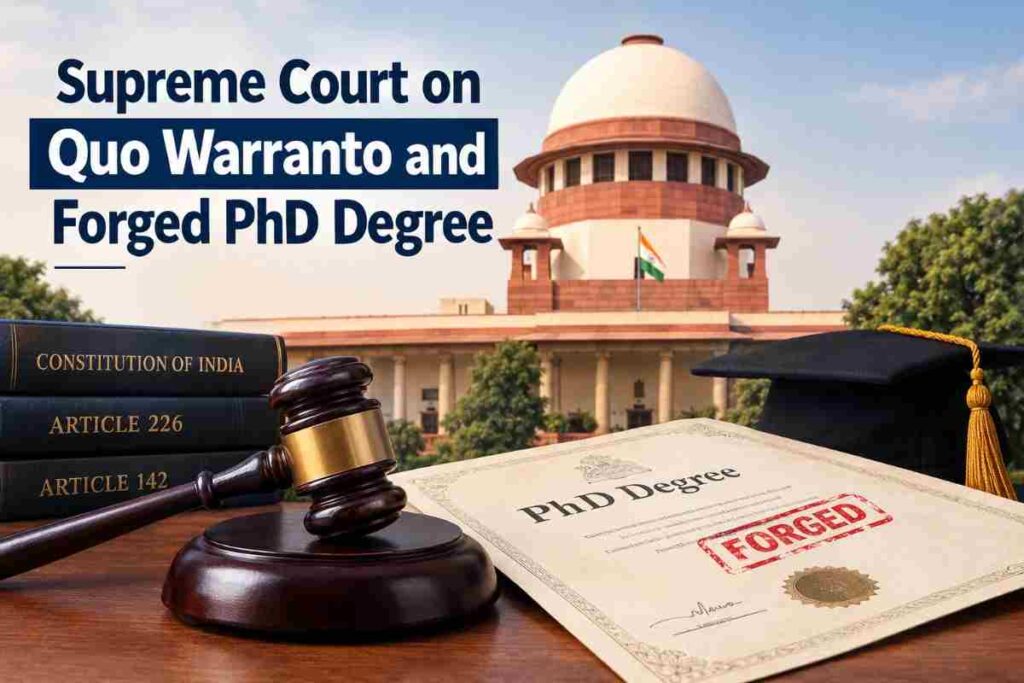

Introduction
Can a person’s appointment to a public office be challenged through a writ of quo warranto merely because the qualification used during the selection process is allegedly forged? The Supreme Court examined this question in Annu Kumar & Anr. v. Maharshi Dayanand University, Rohtak & Ors.
The case concerned the appointment of a candidate as Assistant Professor of Physical Education. The appellants alleged that the selected candidate had obtained the appointment on the strength of a forged Ph.D. degree from Bundelkhand University. However, the record also established that the candidate had qualified the UGC-NET examination, which independently satisfied the mandatory eligibility requirement applicable to the post.
The Supreme Court ultimately declined to disturb the appointment through the present proceedings. At the same time, it found the material concerning the alleged Ph.D. sufficiently serious to direct that Maharshi Dayanand University could conduct an inquiry into the genuineness of the degree. If the degree were ultimately found to be forged and the appointment had been secured through deception, appropriate action, including criminal prosecution, could follow.
The judgment therefore provides an important explanation of the scope of quo warranto, the burden of proof in such proceedings, and the distinction between a mandatory qualification and an additional or desirable qualification.
Case Details
| Particular | Details |
|---|---|
| Case Name | Annu Kumar & Anr. v. Maharshi Dayanand University, Rohtak & Ors. |
| Court | Supreme Court of India |
| Jurisdiction | Civil Appellate Jurisdiction |
| Case Number | Civil Appeal Nos. /2026 arising out of SLP (C) Nos. 24737–24739/2023 |
| Judgment Date | 8 September 2026 |
| Bench | Justice Dipankar Datta and Justice Manmohan |
| Original Proceeding | Civil W.P. No. 34925/2019 |
| Relevant Constitutional Provisions | Articles 226 and 142 |
| Principal Legal Issue | Whether the appointment could be challenged through quo warranto on the allegation of a forged Ph.D. degree |
| Post | Assistant Professor of Physical Education |
The Supreme Court judgment records that the appeals arose from challenges to the dismissal of a writ petition, intra-court appeal and subsequent review proceedings before the Punjab and Haryana High Court.
Background and Facts of the Case
A vacancy for the post of Assistant Professor of Physical Education was advertised by Sat Jinda Kalyana College, Rohtak, Haryana, on 14 February 2018. The college was affiliated with Maharshi Dayanand University.
The appellants, the sixth respondent and 17 other candidates applied for the position. Following the selection process, the sixth respondent emerged as the most-qualified candidate and was appointed as Assistant Professor of Physical Education. The appellants did not figure in the merit list.
Subsequently, a query concerning the authenticity of the sixth respondent’s Ph.D. degree was made through the Right to Information Act, 2005. Information supplied by Bundelkhand University on 11 July 2018 stated that the sixth respondent had never attended a Ph.D. course at that University because no Ph.D. programme had been conducted there during 2011–2014, the period during which the degree was allegedly obtained.
The material before the Supreme Court subsequently included an affidavit from Bundelkhand University’s Registrar or Controller of Examinations. According to the judgment, the affidavit indicated that the claimed Ph.D. degree was “fake and farzi”, while other documents allegedly issued by the University were also stated to be forged or fabricated.
Proceedings Before the High Court
The appellants approached the Punjab and Haryana High Court under Article 226 seeking a writ of quo warranto, alleging that the sixth respondent had obtained a public office on the basis of a forged Ph.D. degree.
The Single Judge dismissed the writ petition.
One important reason was that Maharshi Dayanand University had stated that it independently verified the Ph.D. degree and found it to be in order. The appellants had not filed a rejoinder disputing those factual assertions.
More importantly, the University contended that the sixth respondent had qualified the UGC-NET examination. Since the applicable recruitment criteria permitted a candidate to satisfy the eligibility requirement through Ph.D. qualification or UGC-NET, the controversy concerning the Ph.D. did not, according to the University’s case, remove his eligibility for appointment.
The Division Bench dismissed the intra-court appeal on somewhat different reasoning. It noted that the appellants were not among the top three candidates recommended for appointment and therefore lacked the requisite locus standi. It also considered that quo warranto could not be used simply as a means of vindicating the personal grievance of unsuccessful candidates in a selection process.
What Were the Legal Issues Before the Supreme Court?
The principal questions arising from the judgment were:
- Whether the sixth respondent lacked an essential qualification for appointment as Assistant Professor of Physical Education.
- Whether the alleged forged Ph.D. degree was sufficient to sustain a writ of quo warranto.
- What burden of proof must be discharged by a person seeking quo warranto?
- Whether the sixth respondent’s UGC-NET qualification independently satisfied the mandatory eligibility requirement.
- Whether the Supreme Court should disturb the appointment despite the material indicating that the Ph.D. degree might be forged.
Read This Also: Plaint Cannot Be Rejected Under Order VII Rule 11(a) CPC When It Discloses a Cause of Action
Arguments of the Parties
Appellants’ Case
The appellants challenged the appointment on the ground that the sixth respondent had secured the public office by relying upon a forged Ph.D. degree. Their case was that the alleged qualification demonstrated that the appointment itself was legally vulnerable and justified a writ of quo warranto.
The material subsequently produced before the Supreme Court included communications and an affidavit from Bundelkhand University questioning the genuineness of the degree.
Respondents’ Case
Maharshi Dayanand University disputed the basis of the appellants’ challenge and questioned the authenticity of the RTI material relied upon by them. The University stated that it had independently verified the Ph.D. degree and found it to be in order.
It was also argued that the sixth respondent had independently qualified UGC-NET, which satisfied the eligibility criteria applicable to the appointment. Therefore, even if the controversy concerning the Ph.D. were considered, the respondent remained eligible for appointment.
Supreme Court’s Analysis and Reasoning
1. The applicable qualification had to be identified first
The Supreme Court considered it necessary to determine the minimum qualification required for appointment before examining whether quo warranto could be granted.
The UGC placed before the Court the UGC Regulations concerning minimum qualifications for teachers and other academic staff.
The advertisement had been issued on 14 February 2018, whereas the UGC Regulations, 2018 came into force on 18 July 2018. Consequently, the 2018 Regulations did not apply to this recruitment. The Court therefore examined the earlier regulatory framework, including the 2010 Regulations.
2. UGC-NET was the mandatory qualification
The Court found that, under the applicable framework, qualifying the UGC-NET or an equivalent UGC-accredited test such as SLET/SET constituted the mandatory eligibility requirement, while candidates possessing a Ph.D. degree meeting the applicable requirements were exempted from the NET/SLET/SET requirement.
The recruitment criteria also provided that UGC and State Government rules and relevant service rules would be followed.
Therefore, the Supreme Court concluded that the sixth respondent’s UGC-NET qualification independently fulfilled the essential qualification requirement.
3. What is required for a writ of quo warranto?
This is one of the most significant aspects of the judgment.
The Supreme Court explained that a person seeking quo warranto may even be a stranger to the appointment. However, that person must establish that the appointee did not possess the requisite qualification or suffered from another legal disability making the person disqualified from holding the public office.
Importantly, the Court held that the writ petitioner bears the burden of producing unimpeachable evidence supporting the allegation. If such evidence is produced, the burden shifts to the appointing authority and appointee to rebut it and demonstrate that there was no relevant illegality, irregularity or lack of essential qualification.
This makes the burden of proof a central feature of quo warranto proceedings.
4. A questionable Ph.D. did not automatically invalidate this appointment
The Court made an important distinction between an essential qualification and an additional or desirable qualification.
According to the Court, the post did not make a Ph.D. degree an essential qualification. Instead, the Ph.D. was a desirable qualification. Candidates who did not possess the required NET/SLET/SET qualification were required to possess an appropriate Ph.D. degree.
The sixth respondent had qualified UGC-NET.
Therefore, the Supreme Court held that he could not be treated as lacking the mandatory qualification merely because his Ph.D. degree was questionable.
The Significance of the Allegedly Forged Ph.D.
The Supreme Court nevertheless did not ignore the evidence concerning the Ph.D.
The Court observed that it was possible that the sixth respondent had obtained an advantage over the second and third candidates because marks had been awarded for the questionable Ph.D. qualification.
The Court specifically noted that the situation could have been different had the second or third candidates challenged the appointment.
Thus, the Court distinguished between two questions:
- Was the respondent legally qualified for the post?
- Was the respondent’s Ph.D. degree genuine, and was the selection process affected by deception?
The first question did not justify quashing the appointment through the present quo warranto proceedings because UGC-NET independently satisfied the mandatory qualification.
The second question, however, remained sufficiently serious to warrant an institutional inquiry.
Read This Also: Dhanraj v. State of Rajasthan: Supreme Court Acquits Accused Over Fatal Identification and Medical Evidence Gaps
Judgment / Final Decision
The Supreme Court agreed with the High Court that the writ petition and intra-court appeal did not merit interference. Consequently, the Court did not disturb the sixth respondent’s appointment for the present.
However, exercising its power under Article 142 of the Constitution, the Supreme Court directed that Maharshi Dayanand University could undertake an inquiry into the genuineness of the Ph.D. degree.
The inquiry was to provide procedural safeguards to the sixth respondent. He would be required to produce the original Ph.D. degree in the presence of officials of Bundelkhand University, while those officials would produce the documentary material supporting their affidavit before the Supreme Court.
The sixth respondent was also to receive an opportunity to defend himself and cross-examine witnesses. The inquiry was required to follow the principles of natural justice.
If the inquiry established that the Ph.D. was forged, the University, college, Bundelkhand University or any other person could provide information to the police for prosecution in accordance with law.
The civil appeals were accordingly disposed of, with the parties directed to bear their own costs.
Ratio Decidendi
The core principle emerging from the judgment is that a writ of quo warranto requires proof that the person occupying a public office lacks the mandatory qualification or suffers from a legal disability that disqualifies the person from holding that office.
The person seeking quo warranto must produce unimpeachable evidence establishing the alleged disqualification. Where the appointee independently satisfies the mandatory eligibility requirement, a dispute concerning an additional or desirable qualification does not, by itself, establish that the appointee is legally disqualified from holding the office.
At the same time, evidence suggesting fraud or fabrication in the appointment process may justify an independent inquiry and appropriate action even when the appointment is not set aside in the quo warranto proceedings.
Important Legal Provisions
Article 226 of the Constitution
Article 226 empowers High Courts to issue writs, including a writ of quo warranto.
In this case, the appellants invoked Article 226 to challenge the sixth respondent’s occupation of the post of Assistant Professor.
The judgment demonstrates that quo warranto is concerned with the legal authority to hold a public office, rather than simply providing a remedy for an unsuccessful candidate’s personal grievance.
Article 142 of the Constitution
Article 142 was invoked by the Supreme Court to address the serious material concerning the alleged Ph.D. degree.
Although the Court did not disturb the appointment, it considered an inquiry appropriate and granted Maharshi Dayanand University liberty to investigate the genuineness of the degree.
Important Precedents
The Division Bench of the High Court referred to the following Supreme Court decisions while considering the scope of quo warranto:
| Case | Principle/Subject | Use in the Case |
|---|---|---|
| A.N. Shastri v. State of Punjab | Scope of quo warranto | Relied upon by the High Court while considering the writ |
| R.K. Jain v. Union of India | Scope and ambit of quo warranto | Cited concerning the limits of the remedy |
| Dr B. Singh v. Union of India | Quo warranto jurisdiction | Referred to by the Division Bench |
| B. Srinivasa Reddy v. Karnataka Urban Water Supply & Drainage Board Employees Association | Requirements for quo warranto | Relied upon in assessing the appellants’ challenge |
These authorities are expressly identified in the judgment as decisions relied upon by the Division Bench.
What Does This Judgment Mean?
For litigants
A person challenging a public appointment through quo warranto must focus on the legal disqualification of the appointee, rather than merely showing that the appointment process was controversial.
The evidence supporting the alleged disqualification must be strong and unimpeachable.
For lawyers
The judgment highlights the importance of identifying the actual mandatory eligibility condition before drafting or arguing a quo warranto petition.
If an allegedly fraudulent qualification is not an essential qualification for the post, the legal consequences may be different from a situation where the fraudulent qualification was indispensable to eligibility.
For law students and judiciary aspirants
This case is particularly useful for understanding:
- Article 226;
- writ of quo warranto;
- locus in quo warranto proceedings;
- burden of proof;
- essential versus desirable qualifications;
- Article 142;
- principles of natural justice; and
- the distinction between eligibility and alleged fraud in the selection process.
For public authorities and universities
The judgment also demonstrates that an appointment may not necessarily be immune from further scrutiny merely because a court declines to quash it in a particular proceeding.
Where credible material suggests that a qualification may be forged, the competent authority can undertake an appropriate inquiry and take further action according to law.
Key Takeaways
- Quo warranto challenges the legal authority to hold a public office.
- A petitioner must establish the appointee’s disqualification with unimpeachable evidence.
- The appointee must lack an essential qualification or suffer from another legal disability.
- In this case, UGC-NET independently satisfied the mandatory qualification.
- The Ph.D. qualification was treated as desirable rather than essential for the relevant appointment.
- Therefore, the questionable Ph.D. did not by itself justify setting aside the appointment through the present proceedings.
- The Supreme Court nevertheless considered the alleged forgery sufficiently serious to warrant an inquiry.
- The inquiry must comply with the principles of natural justice.
- If the Ph.D. is ultimately found to be forged, criminal prosecution may be pursued in accordance with law.
- A court’s refusal to disturb an appointment in a quo warranto proceeding does not necessarily prevent competent authorities from investigating alleged fraud.
Frequently Asked Questions
What is the Supreme Court judgment in Annu Kumar v. Maharshi Dayanand University?
The Supreme Court considered a challenge to the appointment of an Assistant Professor where the appointee’s Ph.D. degree was alleged to be forged. The Court did not disturb the appointment because the appointee had independently qualified UGC-NET, which satisfied the mandatory eligibility requirement.
What did the Supreme Court hold about the allegedly forged Ph.D.?
The Court did not finally determine through the present appeals that the appointment should be cancelled on that basis. Instead, it permitted Maharshi Dayanand University to conduct an inquiry into the genuineness of the Ph.D. degree.
Can a writ of quo warranto be filed by a stranger?
Yes. The Supreme Court stated that a writ petitioner seeking quo warranto may even be a stranger, but must establish the appointee’s lack of requisite qualification or another disqualifying disability with unimpeachable evidence.
What is the burden of proof in a quo warranto proceeding?
The petitioner must produce unimpeachable evidence supporting the allegation that the appointee lacks the required qualification or suffers from a disqualification. If such evidence is produced, the onus shifts to the appointee and appointing authority to rebut it.
Was a Ph.D. mandatory for the Assistant Professor post in this case?
No. The Supreme Court found that the Ph.D. was not an essential qualification. The mandatory requirement could be satisfied through UGC-NET/SLET/SET, while the relevant Ph.D. qualification operated as an alternative or desirable qualification in the circumstances considered by the Court.
Why was the appointment not cancelled?
The sixth respondent had qualified UGC-NET, which independently satisfied the mandatory qualification requirement. Consequently, the alleged problem with the Ph.D. did not establish that the respondent lacked the essential qualification for the post.
Did the Supreme Court ignore the allegation of a fake Ph.D.?
No. Although the Court did not disturb the appointment, it directed that the University could conduct an inquiry into the genuineness of the degree.
What happens if the Ph.D. is found to be forged?
The judgment states that if the inquiry finds the Ph.D. to be forged, the University, college, Bundelkhand University or any other person may provide information to the police for prosecution in accordance with law.
What is the importance of Article 142 in this judgment?
The Supreme Court invoked Article 142 to permit an inquiry into the Ph.D. despite declining to grant the appellants the substantive relief of disturbing the appointment.
What is the main ratio of the case?
The main principle is that quo warranto requires proof that an appointee lacks the mandatory qualification or suffers from a legal disability to hold the public office. A dispute concerning a non-essential qualification does not automatically invalidate an appointment when the appointee independently satisfies the mandatory eligibility requirements.


Pingback: Ownership of Premises Does Not Establish Negligence. 106 BNS
Pingback: Bombay High Court Quashes ₹100 Crore PMLA Freeze: Section 8(2) Finding Cannot Be Supplied by Appellate Tribunal